


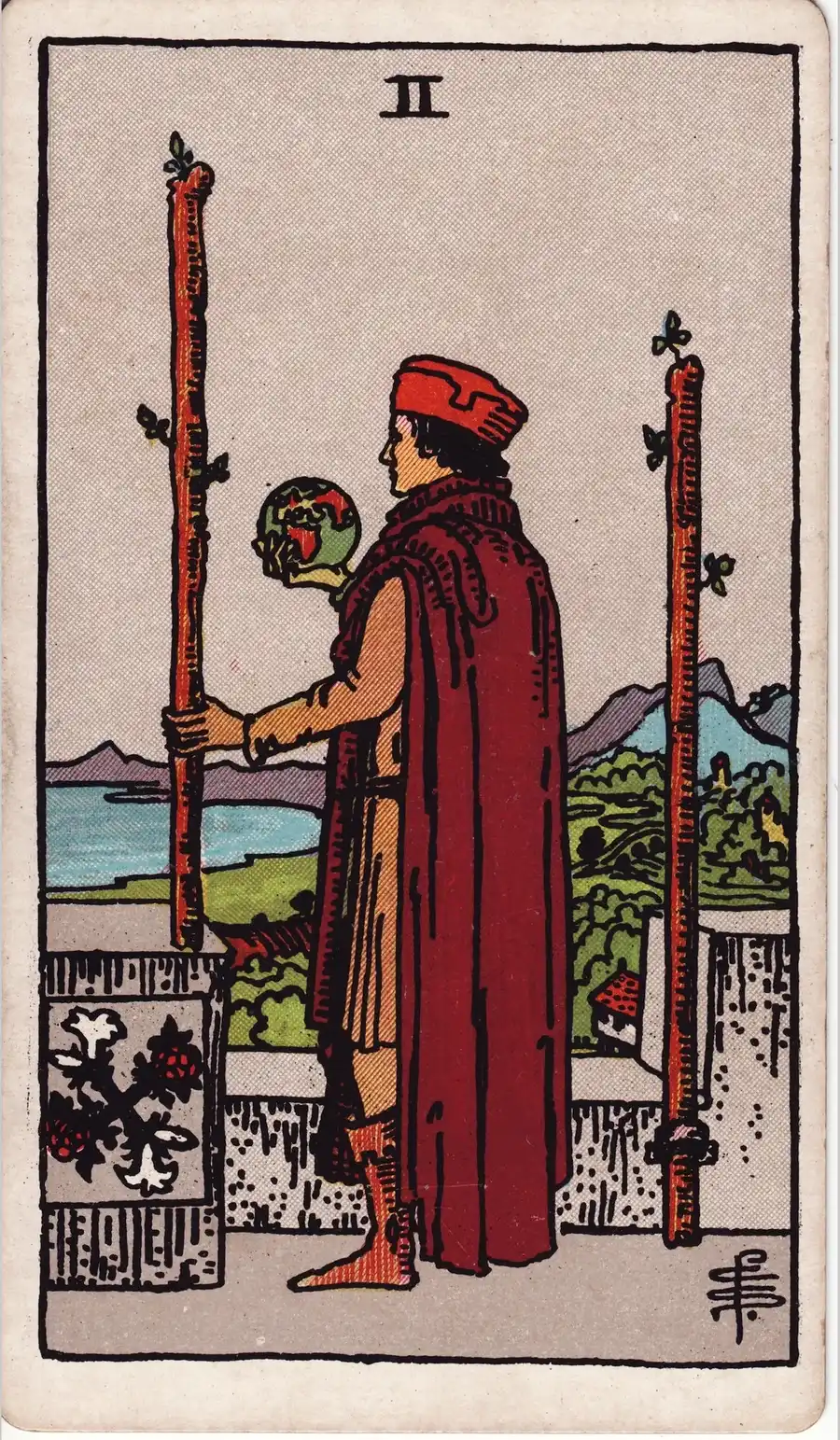
The short answer: the Golden Dawn divided the zodiac into 36 decans of ten degrees and gave each decan two of the 72 spirits of the Ars Goetia, one for the day and one for the night, plus one small card of the tarot. Find the decan of your Sun and you have your birth demon. The calculator below does it from the Sun's real position, not from a fixed list of dates, so it can tell you when your birthday sits on a border. It also shows the second system you will meet online, Dr Rudd's five-degree quinaries.
Find your birth demon
Your result
What a birth demon is
A birth demon is a correspondence, not a curse and not a guardian you are stuck with. In the Golden Dawn way of thinking, everything in the cosmos belongs to a network of matching symbols: planets, signs, colours, Hebrew letters, tarot cards and, in Crowley's tables, the spirits of the Ars Goetia. The decan the Sun occupied on your birthday links you to one point in that network. The spirit attributed to that point is what people now call your birth demon.
The word demon is the old one. The Lemegeton calls these beings spirits, and gives each a rank, an appearance, a number of legions and a list of offices, such as teaching languages, finding lost things or explaining the virtues of herbs. On my pages I keep the old text and the later layers apart, because the birth demon idea belongs to the later layer. The 17th century manuscript itself never assigns its spirits to birthdays.
So your result has three parts. The decan is the ten degrees of a sign, with a planetary ruler. The card is the small card of the tarot given to that decan, from the Two to the Ten of a suit. The spirits are two of the 72, one for a birth by day and one for a birth by night. Each of them has a full page on this site, and you can browse all 72 spirits in the directory.
How the calculator works it out
First it finds the Sun. For the date, time and time zone you enter, it calculates the Sun's ecliptic longitude with the standard low-precision formula from Jean Meeus's Astronomical Algorithms, which is accurate to about a hundredth of a degree, or roughly a quarter of an hour of time. The longitude tells it the sign and the degree, and the degree tells it the decan: 0 to 10, 10 to 20 or 20 to 30.
Without a birth time, it checks the whole calendar day in your time zone. On most days the Sun stays inside one decan from midnight to midnight, and you get one answer. On about one day in ten the Sun crosses into the next decan during the day. Then you see both decans, the moment of the change in your time zone, and a request for your birth time. With a time, it checks half an hour either side, so a rounded clock time on a birth record does not push you into the wrong decan without a warning.
Day or night is your choice, because it depends on sunrise and sunset where you were born, and a birth date alone cannot tell them. If you choose Not sure, the result shows both spirits of your decan. Nothing you enter leaves your browser: there is no account, no storage and no request to a server.
Where the system comes from
Historical The Ars Goetia, the first book of the Lemegeton, survives in 17th century manuscripts. It lists 72 spirits with their seals and offices. Its catalog is close to Johann Weyer's Pseudomonarchia daemonum of 1577, which has 69. Neither text links the spirits to decans or to tarot cards. You can read how the list grew in my history of the Goetia.
The Golden Dawn and Crowley
Later tradition The attribution to decans comes from the Hermetic Order of the Golden Dawn and from Aleister Crowley, who printed it in his table book Liber 777 in 1909. The edition of the Goetia that Crowley published with S. L. MacGregor Mathers in 1904 already carried a chart that places the spirit numbers around the zodiac. The rule is simple once you see it: spirits 1 to 36 are the day spirits and spirits 37 to 72 the night spirits, both starting at 0 degrees Aries and running in order through the 36 decans. So Bael and Phenex share the first decan of Aries, Agares and Halphas the second, and Stolas and Andromalius close the circle in the last decan of Pisces. I tell the story of that edition in Mathers and Crowley, 1904.
The small cards come from the same Golden Dawn table: the cardinal signs take the Twos, Threes and Fours, the fixed signs the Fives, Sixes and Sevens, and the mutable signs the Eights, Nines and Tens, in the suit of the sign's element. The planetary rulers of the decans follow the old Chaldean order, starting with Mars in the first decan of Aries.
Modern reference books
Modern Lon Milo DuQuette and Christopher Hyatt reprinted the attributions spirit by spirit in Aleister Crowley's Illustrated Goetia (1992), and Stephen Skinner set them beside dozens of other systems in The Complete Magician's Tables (2006). I checked every row of the table below against the 1904 chart and those two books. The phrase birth demon itself is modern: you will not find it in any of them.
All 36 decans, cards and spirits
The last column shows when the Sun enters each decan in 2026, in UTC. In other years the date can move by a day either way, which is exactly why the calculator does not use a fixed list. Every card and spirit links to its own page.
Cusps, leap days and moving dates
Most lists of birth demons give fixed dates, such as 21 to 30 March for Bael. Those dates are an average. The calendar year is 365 or 366 days long and the Sun's circle is not quite either, so the moment the Sun reaches a given degree drifts by several hours from year to year and then jumps back after each leap day. The spring equinox, the start of Aries, fell on 21 March in 1950 and on 20 March in 2000 and 2024. Someone born on 20 March 1950 belongs to the last decan of Pisces; someone born on 20 March 2024 after 03:06 UTC belongs to the first decan of Aries.
Leap day is a good example. On 29 February the Sun reaches 10 degrees Pisces, the border between the Eight and the Nine of Cups, in every leap year I tested from 1960 to 2024. So if you were born on 29 February, the calculator will nearly always ask for your time: before the crossing your spirits are Furfur and Seere, after it Marchosias and Dantalion.
Be careful with copied tables, too. I have seen published lists with a decan that seems to end before it begins, and lists where two decans of Libra carry the same degrees. The pattern behind the system is regular, so the safest check is the one above: day spirit number equals decan number, night spirit number equals decan number plus 36.
Why books give different birth demons
If you compare sites, you will soon find two answers for the same birthday. Both come from real sources; they just divide the zodiac differently. The calculator above shows both side by side.
Golden Dawn decans, ten degrees. This is the system described above, from Crowley's Liber 777 and the 1904 chart. Each decan holds two spirits, one for a day birth and one for a night birth, and one small card of the tarot.
Dr Rudd's quinaries, five degrees. A 17th century manuscript connected with Dr Thomas Rudd, British Library Harley MS 6483, sets each Goetic spirit against the angel of the Shem ha-Mephorash with the same number. Stephen Skinner and David Rankine published it as The Goetia of Dr Rudd (2007). The 72 angels each rule five degrees from 0 Aries, so spirit and angel share one slice: Bael and Vehuiah have Aries 0 to 5, Agares and Jeliel Aries 5 to 10, and Andromalius and Mumiah close the circle at the end of Pisces. There is no day or night split here.
The two systems agree on Bael at the very start of Aries, then drift apart. A night birth on 21 October 1990 gives Ose in the decans, but Vepar, with the angel Mikael, in Rudd's quinaries; Rudd places Ose in Capricorn.
Smaller differences come from copying. Many tables print fixed dates such as 21 to 25 March, which can be a day off in a given year. Published lists also repeat date ranges, list one angel twice or spell the angel names in several ways. If a result looks odd, check the degrees, not the dates, and note which system the source uses.
What to do with your result
Start by reading. Open the page of your spirit and read what the 1904 text actually says, then the older versions in Weyer and Scot where they exist. Then look at your decan card: the Two of Wands, say, or the Seven of Swords. The card is often the most useful part of the result, because you can hold it, look at the 1909 drawing and ask what it shows about the season you were born into. My pages on the Minor Arcana and on numbers and elements in tarot help with that.
Treat the spirits with the same respect you would give any old text that people have taken seriously for centuries. You can be curious about a spirit without calling it, and you can stop at study for as long as you like. If you do want to explore ritual one day, read my safety and ethics page and how I choose a first spirit first. Nothing in this calculator asks you to do anything.
A simple practice: write your decan, card and both spirits in your notebook. Once a week for a month, read one paragraph about one of them and write two lines about what stayed with you. At the end of the month, see which part of the result you kept returning to. That is usually the thread worth following.
Common questions
What is a birth demon?
In the Golden Dawn system, your birth demon is the spirit of the Ars Goetia that rules the decan, the ten-degree slice of the zodiac, the Sun was in when you were born. Each decan has a day spirit and a night spirit, so 36 decans hold all 72 spirits.
Is my birth demon evil, or a sign that something is wrong with me?
No. The pairing is a system of correspondences made by 19th and 20th century occultists, not a verdict on your character. Many readers use their birth spirit as a study theme: they read its entry, its card and its history, and nothing more.
Why do websites give me different birth demons?
Mostly because they use different systems. The Golden Dawn decans give each ten degrees of the zodiac a day spirit and a night spirit, while Dr Rudd's manuscript gives each spirit five degrees of its own with a Shem ha-Mephorash angel. Fixed calendar dates and copying errors add more differences. The calculator shows both systems from the Sun's real position, so you can see which one another site used.
Do I need my birth time?
Only on a cusp day, when the Sun moved from one decan to the next. The calculator tells you when that happens and shows both decans until you add a time. The time also does not decide day or night by itself, because sunrise depends on where you were born.
Should I try to summon my birth demon?
You never have to. Knowing the name is not a contract and reading about a spirit does not call it. If you are curious about ritual work, read my safety and ethics page first and take your time.
Which tarot card goes with my birth demon?
The small card of your decan, from the Two to the Ten of a suit. For example, the first decan of Aries is the Two of Wands, shared by Bael by day and Phenex by night. The calculator shows the card with its 1909 image and links to my full card page.