


| Arcana | Major Arcana |
|---|---|
| Number | VI |
| Image | RWS 1909 (PD) |
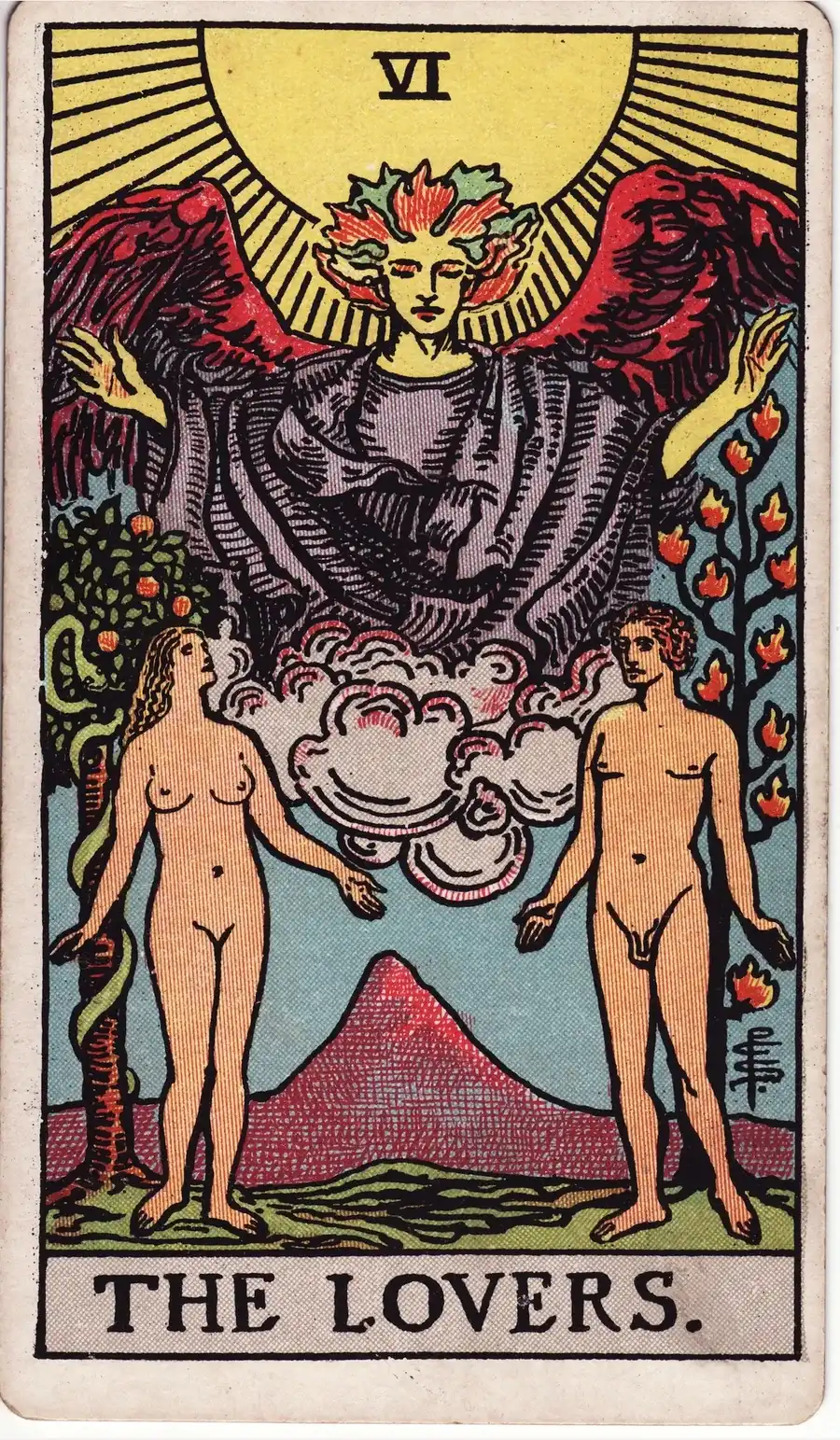
The Lovers is card VI of the Major Arcana, and it is about more than romance. Under a great angel two people stand in a garden, each in front of a tree.
The card asks what you are choosing, and whether your heart and your values point the same way. Here is what the Lovers means upright and reversed, the symbols in the 1909 design and how an old card about marriage became a card about choice.
Here is the Lovers at a glance.
| At a glance | This card |
|---|---|
| Upright keywords | love, union, choice, shared values |
| Reversed keywords | misalignment, broken trust, a choice postponed |
| Number | VI (6) in the Major Arcana |
| Golden Dawn title | The Children of the Voice; the Oracle of the Mighty Gods Later tradition |
| Hebrew letter | Zayin (ז), “sword” Later tradition |
| Tree of Life path | 17, from Binah to Tiphareth Later tradition |
| Astrology | Gemini Later tradition |
| Element | Air Later tradition |
| Yes or no | Yes Modern |
The Golden Dawn gave the Lovers the sign Gemini, the twins, and the letter Zayin, the “sword” that divides. The sword suits a card about choosing. Older Marseille cards show a young man standing between two women while Cupid aims from above, a choice between two loves. Waite replaced that scene with Adam and Eve beneath a great angel, often identified today as Raphael, changing the card from a choice of partners into a card of union and conscience.
The card: what Pamela Colman Smith drew
The 1909 card shows a man and a woman standing unclothed in a garden, with an angel above them in the sun, a tree of flames behind him and a fruit tree with a serpent behind her. Waite called the Lovers “in all simplicity the card of human love” and said it shows love “as part of the way, the truth and the life”.
The angel and the sun. Above the figures a great winged angel, usually read as Raphael, spreads its arms under a blazing sun. It is a blessing over the choice below. Love here is not only private. It is something you stand behind in daylight.
The two trees. Behind the man is a tree of flames, which Waite called the Tree of Life with twelve fruits. Behind the woman is the Tree of the Knowledge of Good and Evil, with a snake wound around it. The garden is Eden, and the theme is choice and its consequences.
The mountain. Between the two figures rises a single mountain. Many readers see it as the shared aim that a real partnership climbs toward together.
The two figures. The man looks at the woman, and the woman looks up at the angel. The order of the gazes has been read many ways, but the simple point is connection: two people turned toward each other, and toward something larger.
Upright meaning
Upright, the Lovers is a card of union and of choosing. In Smith’s picture a naked man and woman stand in a garden beneath a great angel and a blazing sun. Behind the woman is the tree of knowledge with the serpent coiled around it; behind the man, a tree whose fruits are flames. Nothing is hidden. The card describes a bond in which both people are seen as they are.
In love readings it means strong attraction and deep connection, but the card is broader than romance. It is about alignment between what you value and what you do. When the Lovers appears, a choice is usually near, and the right answer is the one you could make openly, without needing to hide or explain it away.
The card also speaks of partnerships of every kind: a business partner, a creative collaboration or a friendship that changes both people.
Reversed meaning
Reversed, something is out of alignment. In a relationship, that can mean imbalance, poor communication, temptation or two people wanting different things and not saying so. It can also mean a choice being avoided, such as staying because leaving is frightening, or saying yes while meaning no.
The reversed Lovers often turns the question inward. Are your actions matching your values? Small compromises, each easy to justify, can add up to a life that no longer feels like yours.
Name the choice you have been postponing, and write down what you value most in this situation. The answer often becomes clear once the two are side by side.
In love, work and spirituality
In love. Upright: Deep connection, mutual attraction and honest commitment. A relationship that matters. Reversed: Disharmony, temptation, or a decision about the relationship being put off.
At work. Upright: A strong partnership or collaboration; a career choice that fits your values. Reversed: Conflict between partners, or work that asks you to compromise your ethics.
With money. Upright: Joint finances handled openly; decisions made together. Reversed: Money disagreements in a partnership, or a choice between security and integrity.
In spiritual practice. Upright: Union of opposites; a practice that brings head and heart together. Reversed: Inner conflict: saying you believe one thing and living another.
As feelings. Strong attraction and real emotional connection.
As a person. Someone who leads with the heart and cares about harmony and honesty.
As advice. Choose what you value, openly, and let your actions match it.
Reading the Lovers: positions and yes or no
In the past position: A relationship or a choice that shaped who you are. In the present position: An important choice, or a connection that asks you to commit.
In the future position: A meaningful relationship or decision is coming. As advice: Choose with your heart and your values together.
When the Lovers shows up among mostly Minor cards, give it extra weight: the theme of love runs under the whole question.
In modern yes or no readings, the Lovers leans yes. It is a card of love and good choices, so it leans yes, as long as the choice fits your values.
The history and art behind the card
In the Tarot de Marseille pattern the card is called L’Amoureux, the Lover. The earliest Italian cards show a couple, sometimes on their wedding day, with Cupid flying above them.
On many Marseille cards a young man stands between two women, one older and one younger, while Cupid aims an arrow at him. That version is about a choice between two paths or two loves.
Waite disliked the old design. He wrote that his card replaces “the old card of marriage” and “the later follies which depicted man between vice and virtue”.
Smith gave it the Eden scene, which turned the card into a picture of human love and moral choice at once. The Golden Dawn gave it Gemini, the twins, a good match for a card about two.
When A. E. Waite published The Pictorial Key to the Tarot in 1910, he listed these divinatory meanings for the card: “Attraction, love, beauty, trials overcome.” Reversed, he gave: “Failure, foolish designs. Another account speaks of marriage frustrated and contrarieties of all kinds.”
Waite himself called the fortune-telling meanings of the trumps “artificial and arbitrary”, and on this site I read the picture first and treat lists like this as history.
In the modern Fool’s Journey, the Lovers is the first card where the traveler must choose rather than receive. After the Hierophant’s inherited rules, this is the moment of deciding what you value for yourself, in love or anywhere else.
Common questions
Does the Lovers always mean love? No. It often means a relationship, but it can also mean an important choice or a question of values.
Is the Lovers a yes? Usually yes, especially in love questions. Reversed, it asks you to look at what is out of balance first.
Try this
Try this small spread for the Lovers. Use it for a relationship or for any choice between two paths.
| Card | Question | What it shows |
|---|---|---|
| 1 | What draws me here? | The attraction or the pull. |
| 2 | What do my values say? | The test the choice has to pass. |
| 3 | What does choosing this ask of me? | The commitment that comes with it. |
Affirmation: I choose connection that aligns with my values and my heart.
Reversed affirmation: I face misalignment honestly instead of performing unity.
If you keep a tarot journal, take one of these questions to it: What choice am I facing, and what do my values say? Where do my heart and my head agree? What would it look like to choose this relationship, or this path, again today?
What next
Cards that sit close to this one are The Hierophant (the card before: shared values and tradition), The Devil (the shadow of the Lovers, attachment without freedom) and The Empress (love as care and growth).
The Lovers is part of the lesson The Fool to the Chariot in my free Tarot for Beginners course. To keep walking the Major Arcana, read the card before it, The Hierophant or the card after it, The Chariot, or go back to all the card meanings.
For every card with keywords, affirmations and examples, see my book The Novice’s Guide to Tarot. If you would like a printable cheat sheet for all 78 cards, my 45-page Tarot Workbook is on Etsy.
Sources
- A. E. Waite, The Pictorial Key to the Tarot (London: Rider, 1910), Part II and Part III, section 3.
- Pamela Colman Smith and A. E. Waite, the Rider-Waite-Smith tarot (London: Rider, 1909).
- Nicolas Conver, Tarot de Marseille (Marseille, 1760).
- Eden Gray, A Complete Guide to the Tarot (New York: Crown, 1970), epilogue “The Fool’s Journey”.
- Lauri Mukkala, The Novice’s Guide to Tarot, entry for The Lovers.
- Aleister Crowley, 777 (London: Walter Scott, 1909), columns of the Hebrew letters, paths and Tarot trumps.
- Israel Regardie, ed., The Golden Dawn (Chicago: Aries Press, 1937 to 1940), “Book T” and the titles of the trumps.
All 78 cards
Major Arcana
- The Fool
- The Magician
- The High Priestess
- The Empress
- The Emperor
- The Hierophant
- The Lovers
- The Chariot
- Strength
- The Hermit
- Wheel of Fortune
- Justice
- The Hanged Man
- Death
- Temperance
- The Devil
- The Tower
- The Star
- The Moon
- The Sun
- Judgement
- The World
Wands
- Ace of Wands
- Two of Wands
- Three of Wands
- Four of Wands
- Five of Wands
- Six of Wands
- Seven of Wands
- Eight of Wands
- Nine of Wands
- Ten of Wands
- Page of Wands
- Knight of Wands
- Queen of Wands
- King of Wands
Cups
- Ace of Cups
- Two of Cups
- Three of Cups
- Four of Cups
- Five of Cups
- Six of Cups
- Seven of Cups
- Eight of Cups
- Nine of Cups
- Ten of Cups
- Page of Cups
- Knight of Cups
- Queen of Cups
- King of Cups
Swords
- Ace of Swords
- Two of Swords
- Three of Swords
- Four of Swords
- Five of Swords
- Six of Swords
- Seven of Swords
- Eight of Swords
- Nine of Swords
- Ten of Swords
- Page of Swords
- Knight of Swords
- Queen of Swords
- King of Swords
Pentacles
Get the free Mini-Grimoire
A short printable starter guide to tarot and everyday witchcraft, plus my newsletter. Unsubscribe any time.
Opens Substack in a new tab to confirm. More about the newsletter · Privacy