


| Arcana | Minor Arcana: Cups |
|---|---|
| Image | RWS 1909 (PD) |
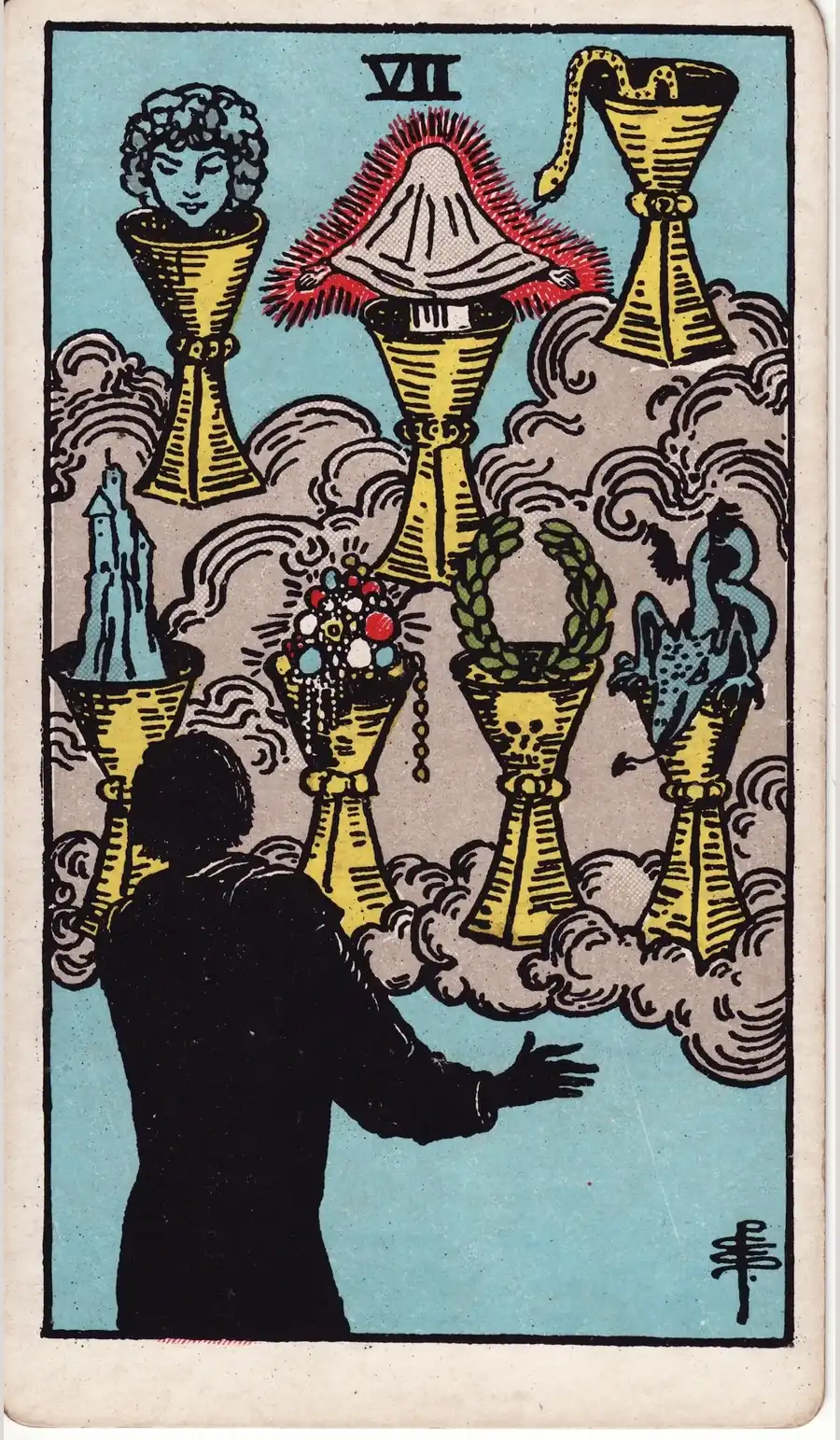
The Seven of Cups shows a person, seen from behind, facing seven cups floating in the clouds. Each cup holds something strange or tempting: a castle, jewels, a dragon, a laurel wreath, a snake, a head and a glowing veiled figure.
It is a card of fantasy, choices and illusion. This page covers what the Seven of Cups means upright and reversed, the symbols in the 1909 card and a spread for sorting dreams from plans.
Here is the Seven of Cups at a glance.
| At a glance | This card |
|---|---|
| Upright keywords | fantasy, illusion, choices |
| Reversed keywords | confusion, lack of clarity, overwhelm |
| Number | 7 in the suit of Cups |
| Golden Dawn title | Lord of Illusionary Success Later tradition |
| Astrology | Venus in Scorpio, third decan (20° to 30° Scorpio) Later tradition |
| Tree of Life | Netzach (7), Victory Later tradition |
| Suit and element | Cups, Water Later tradition |
| Yes or no | Maybe Modern |
The Golden Dawn named the Seven of Cups the Lord of Illusionary Success and gave it Venus in Scorpio, the last decan of the sign, on Netzach. Venus is weak in Scorpio by traditional astrology, so desire is seen through a distorting lens. The title says it plainly: a success that may not be real.
Later tradition The Golden Dawn also gave each decan two of the 72 Goetic spirits, one for the day and one for the night. For the third decan of Scorpio, and so for the Seven of Cups, they are Naberius (spirit 24, day) and Vapula (spirit 60, night). Their pages read the old entries as history; see the spirit directory for all 72.
The card: what Pamela Colman Smith drew
Waite called them “strange chalices of vision” and said the images are “more especially those of the fantastic spirit”. The figure in the foreground is only a dark silhouette. The cups glow in the clouds like daydreams.
Seven cups in the clouds. The cups float in clouds, not on solid ground. They are possibilities and imaginings, not yet real things you can hold.
Mixed contents. Some cups hold rewards like jewels, a castle and a wreath of victory. Others hold a dragon and a snake. Not every dream is good for you, and some are fears dressed up as wishes.
The veiled figure. In the center cup is a glowing figure under a veil. Many readers see the true goal hidden among the distractions, or a spiritual calling you can only see once the rest clears.
Upright meaning
Upright, the Seven of Cups is a field of choices and fantasies. A figure, seen from behind, faces seven cups floating in clouds, each holding a different vision: a castle, jewels, a wreath, a dragon, a snake, a head and a veiled glowing figure. Some are tempting, some frightening, and all of them are made of cloud.
The card appears when you have many options and no way yet to tell which are real. It speaks of daydreaming, wishful thinking and imagination. Imagination is valuable, but the Seven of Cups warns that not every vision can be lived, and some are illusions.
Choose one cup and test it against reality. A plan you can act on is worth more than seven dreams you only admire.
Reversed meaning
Reversed, the Seven of Cups can show the clouds clearing. You see which options are real and make a choice. It can also show the opposite: confusion so deep that you cannot decide, or escape into fantasy to avoid a real decision.
Ask which option would still look good in plain daylight. Write down the practical steps for each one. The illusions will usually reveal themselves.
In a reading, the cup that frightens you is as worth examining as the one that tempts you. The dragon and the snake in Smith’s picture are also illusions. Sometimes the reversed Seven shows that the fear holding you back was never as solid as it looked.
In love, work and spirituality
In love. Upright: Many options, or idealizing someone you hardly know. Reversed: Seeing a partner clearly at last, or confusion about what you want.
At work. Upright: Many ideas, or a choice between several paths. Research before deciding. Reversed: Clarity about which project to pursue, or overwhelm from too many.
With money. Upright: Tempting offers. Check them carefully before committing. Reversed: Seeing through a scheme that seemed too good to be true.
In spiritual practice. Upright: Visions, vivid dreams and active imagination. Reversed: Confusing fantasy with spiritual insight.
As feelings. Dreamy, uncertain, perhaps idealizing you or the relationship.
As a person. An imaginative dreamer who has many ideas and finds it hard to choose.
As advice. Choose one dream and test it against reality.
Reading the Seven of Cups: positions and yes or no
In the past position: Too many options, or a dream, pulled you in many directions. In the present position: You have many choices. Look closely at each one.
In the future position: Options and temptations will appear. Choose with care. As advice: Pick one dream and take one real step.
In modern yes or no readings, the Seven of Cups is a maybe. Too many options cloud the answer.
What the Seven means, and the history behind the card
Seven tests what was gained, and in Cups the test is telling desire from illusion. The Golden Dawn’s Illusionary Success gives the warning in two words.
Here is how the Seven looks across the four suits:
- Seven of Wands: defense, perseverance, challenge
- Seven of Cups (this card): fantasy, illusion, choices
- Seven of Swords: deception, trickery, strategy
- Seven of Pentacles: patience, long-term planning, assessment
When A. E. Waite published The Pictorial Key to the Tarot in 1910, he listed these divinatory meanings for the Seven of Cups: “Fairy favors, images of reflection, sentiment, imagination, things seen in the glass of contemplation; some attainment in these degrees, but nothing permanent or substantial is suggested.”
Reversed, he gave: “Desire, will, determination, project.”
Common questions
Is the Seven of Cups a yes or no card? It is a maybe. There are too many options for a clear answer.
What does the Seven of Cups mean in love? Fantasy, choices or wishful thinking. Look at the real person, not the dream of them.
Is the Seven of Cups a bad card? No. It shows imagination and possibility. It only warns against confusing daydreams with decisions.
Try this
Try this small spread for the Seven of Cups. Use it when you have too many options.
| Card | Question | What it shows |
|---|---|---|
| 1 | What am I dreaming of? | The most tempting option. |
| 2 | What is the reality? | What this choice would really involve. |
| 3 | Which cup should I choose? | The option to bring down to earth. |
Affirmation: I sort attractive possibilities until one earns a real try.
Reversed affirmation: I clear the fog enough to make one workable choice.
If you keep a tarot journal, take one of these questions to it: Which of my dreams would I still want if nobody saw it? Which cup holds a fear dressed as a wish? What would a first real step toward one dream look like?
What next
Cards that sit close to this one are The Moon (the Major Arcana card of illusion and the imagination), Two of Swords (a frozen choice between two options) and The Lovers (the Major Arcana card of making a heart-led choice).
The Seven of Cups is part of the lesson Cups in my free Tarot for Beginners course. To see the whole suit on one page, go to the suit of Cups. To keep walking the suit, read the card before it, Six of Cups or the card after it, Eight of Cups, or go back to all the card meanings.
For the suits and numbers in one place, see The Minor Arcana: suits and numbers made simple. For every card with keywords, affirmations and examples, see my book The Novice’s Guide to Tarot. If you would like a printable cheat sheet for all 78 cards, my 45-page Tarot Workbook is on Etsy.
Sources
- A. E. Waite, The Pictorial Key to the Tarot (London: Rider, 1910), Part III, sections 1 and 2.
- Pamela Colman Smith and A. E. Waite, the Rider-Waite-Smith tarot (London: Rider, 1909).
- Nicolas Conver, Tarot de Marseille (Marseille, 1760).
- Lauri Mukkala, The Novice’s Guide to Tarot, entry for the Seven of Cups.
- Aleister Crowley, 777 (London: Walter Scott, 1909), columns of the decans, the Minor Arcana and the court cards.
- Israel Regardie, ed., The Golden Dawn (Chicago: Aries Press, 1937 to 1940), “Book T”, titles and attributions of the small cards and the court.
All 78 cards
Major Arcana
- The Fool
- The Magician
- The High Priestess
- The Empress
- The Emperor
- The Hierophant
- The Lovers
- The Chariot
- Strength
- The Hermit
- Wheel of Fortune
- Justice
- The Hanged Man
- Death
- Temperance
- The Devil
- The Tower
- The Star
- The Moon
- The Sun
- Judgement
- The World
Wands
- Ace of Wands
- Two of Wands
- Three of Wands
- Four of Wands
- Five of Wands
- Six of Wands
- Seven of Wands
- Eight of Wands
- Nine of Wands
- Ten of Wands
- Page of Wands
- Knight of Wands
- Queen of Wands
- King of Wands
Cups
- Ace of Cups
- Two of Cups
- Three of Cups
- Four of Cups
- Five of Cups
- Six of Cups
- Seven of Cups
- Eight of Cups
- Nine of Cups
- Ten of Cups
- Page of Cups
- Knight of Cups
- Queen of Cups
- King of Cups
Swords
- Ace of Swords
- Two of Swords
- Three of Swords
- Four of Swords
- Five of Swords
- Six of Swords
- Seven of Swords
- Eight of Swords
- Nine of Swords
- Ten of Swords
- Page of Swords
- Knight of Swords
- Queen of Swords
- King of Swords
Pentacles
Get the free Mini-Grimoire
A short printable starter guide to tarot and everyday witchcraft, plus my newsletter. Unsubscribe any time.
Opens Substack in a new tab to confirm. More about the newsletter · Privacy