


| Arcana | Minor Arcana: Cups |
|---|---|
| Image | RWS 1909 (PD) |
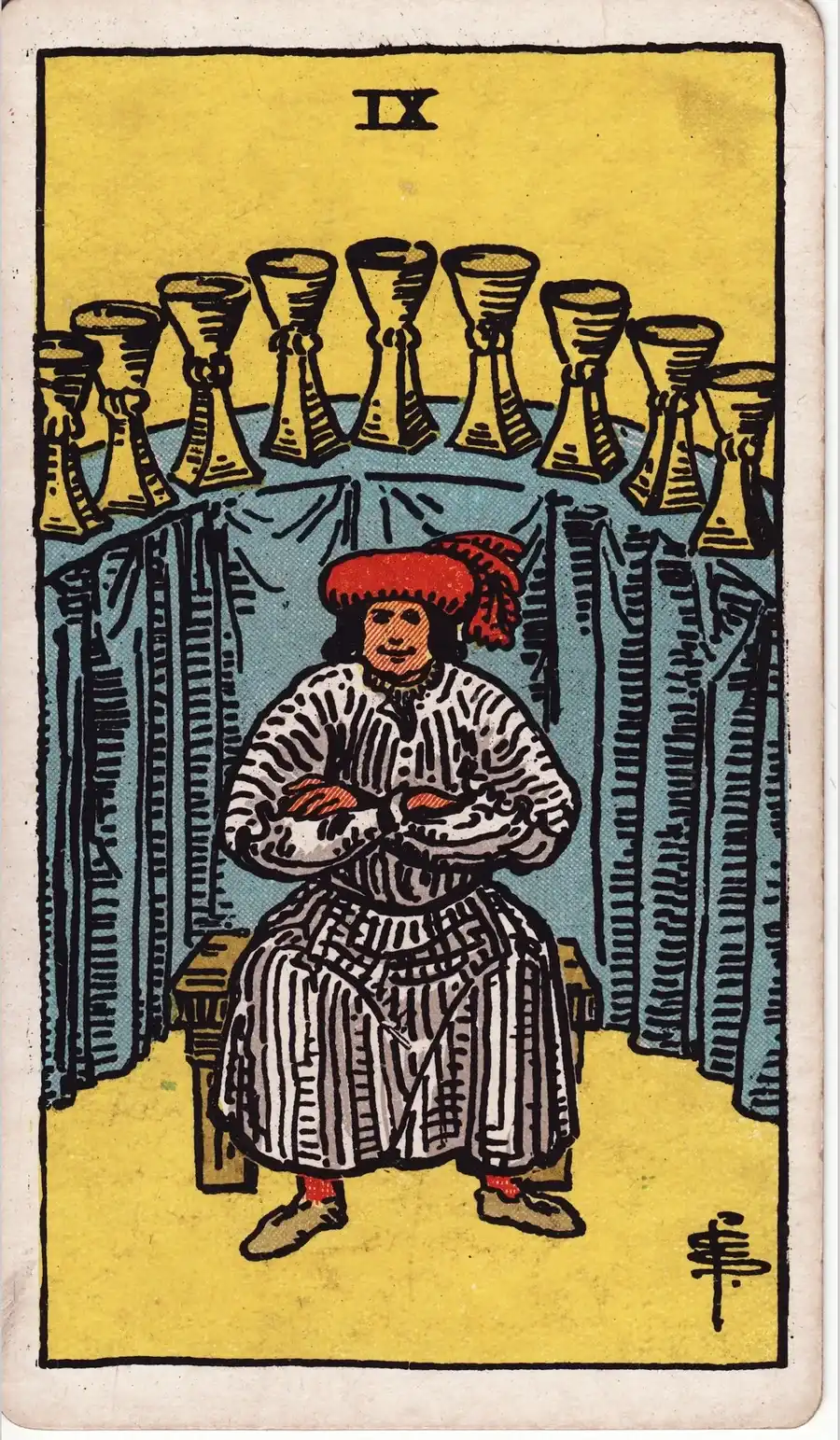
The Nine of Cups shows a well-fed man sitting on a bench with his arms crossed and a satisfied smile, while nine golden cups stand on a curved shelf behind him. It is often called the wish card.
It is about satisfaction, contentment and getting what you hoped for. This page covers what the Nine of Cups means upright and reversed, the symbols Pamela Colman Smith drew and how to read it in love and work.
Here is the Nine of Cups at a glance.
| At a glance | This card |
|---|---|
| Upright keywords | satisfaction, contentment, emotional fulfillment |
| Reversed keywords | dissatisfaction, materialism, indulgence |
| Number | 9 in the suit of Cups |
| Golden Dawn title | Lord of Material Happiness Later tradition |
| Astrology | Jupiter in Pisces, second decan (10° to 20° Pisces) Later tradition |
| Tree of Life | Yesod (9), Foundation Later tradition |
| Suit and element | Cups, Water Later tradition |
| Yes or no | Yes Modern |
The Golden Dawn named the Nine of Cups the Lord of Material Happiness and gave it Jupiter in Pisces, the middle decan of the sign, on Yesod. Jupiter traditionally rules Pisces, so the decan is generous and expansive. This is the card many readers still call the wish card.
Later tradition The Golden Dawn also gave each decan two of the 72 Goetic spirits, one for the day and one for the night. For the second decan of Pisces, and so for the Nine of Cups, they are Marchosias (spirit 35, day) and Dantalion (spirit 71, night). Their pages read the old entries as history; see the spirit directory for all 72.
The card: what Pamela Colman Smith drew
Waite wrote: “A goodly personage has feasted to his heart’s content, and abundant refreshment of wine is on the arched counter behind him, seeming to indicate that the future is also assured.” He added that “the picture offers the material side only, but there are other aspects.”
The satisfied smile. He looks pleased with himself and with life. This is a card where pleasure is allowed. You do not need to apologize for enjoying what you have.
Nine cups on display. The cups stand in a curved row behind him like trophies. His fulfillment is visible. Some readers see a hint of showing off, which is the card’s small warning.
Crossed arms. His arms are folded. It can mean contentment, or it can mean he is keeping his good fortune to himself. Read it with the cards around it.
Upright meaning
Upright, the Nine of Cups is satisfaction. A well-fed man sits with crossed arms and a contented smile in front of nine golden cups on a curved shelf. Many readers call it the wish card, because it often appears when something you wanted is about to come true.
The card speaks of comfort, pleasure and emotional fulfillment, the feeling of having enough. It is a good card for health, celebrations and personal satisfaction. It invites you to enjoy what you have without guilt.
The crossed arms can also hint at self-satisfaction. Contentment is a gift, but it is best when shared. Notice whether your happiness has room for others.
Reversed meaning
Reversed, the Nine of Cups can show a wish that does not satisfy once it is granted, or happiness that depends on things rather than meaning. It can also show overindulgence, smugness or the feeling that you should be happy but are not.
Ask what you really wish for under the surface wish. Sometimes the reversed Nine is a reminder that contentment comes from inside, not from the shelf.
Reversed, the wish card can also appear when a wish is granted in a different form than you imagined. Before deciding you are disappointed, look at what actually arrived. It may be closer to what you needed than the version you were picturing.
In love, work and spirituality
In love. Upright: Happiness, satisfaction and a wish coming true. Reversed: A relationship that looks perfect but feels empty, or indulgence over intimacy.
At work. Upright: Recognition, comfort and a job well done. Reversed: Success that does not feel fulfilling.
With money. Upright: Comfort and enjoyment of what you have earned. Reversed: Overspending, or money not bringing the happiness you expected.
In spiritual practice. Upright: Gratitude practice and contentment. Reversed: Spiritual complacency.
As feelings. Happy and content. They are pleased with the relationship.
As a person. Someone content, generous and comfortable with themselves, sometimes smug.
As advice. Enjoy what you have, and make your wish clearly.
Reading the Nine of Cups: positions and yes or no
In the past position: A wish came true, or a contented time gave you strength. In the present position: You have reason to be satisfied. Enjoy it.
In the future position: A wish may be granted. As advice: Name what you are grateful for.
In modern yes or no readings, the Nine of Cups leans yes. It is traditionally the wish card.
What the Nine means, and the history behind the card
Nine is the suit at its fullest, and in Cups fullness means emotional satisfaction. The Golden Dawn called it the Lord of Material Happiness, a reminder that happiness also lives in the body and the comforts of life.
Here is how the Nine looks across the four suits:
- Nine of Wands: resilience, persistence, last stand
- Nine of Cups (this card): satisfaction, contentment, emotional fulfillment
- Nine of Swords: anxiety, worry, fear
- Nine of Pentacles: self-sufficiency, luxury, abundance
When A. E. Waite published The Pictorial Key to the Tarot in 1910, he listed these divinatory meanings for the Nine of Cups: “Concord, contentment, physical bien-être; also victory, success, advantage; satisfaction for the Querent or person for whom the consultation is made.”
Reversed, he gave: “Truth, loyalty, liberty; but the readings vary and include mistakes, imperfections, etc.”
Common questions
Is the Nine of Cups a yes or no card? Yes. It is known as the wish card.
What does the Nine of Cups mean in love? Contentment and fulfillment. Reversed, dissatisfaction or chasing more.
What is the difference between the Nine and the Ten of Cups? The Nine is personal satisfaction. The Ten widens it into shared happiness with family or chosen family.
Try this
Try this small spread for the Nine of Cups. Use it when you want to look at a wish.
| Card | Question | What it shows |
|---|---|---|
| 1 | What do I truly wish for? | The wish under the wish. |
| 2 | What already satisfies me? | The fulfillment I already have. |
| 3 | How do I welcome more? | One way to make room for joy. |
Affirmation: I recognize satisfaction when it arrives and enjoy it without apology.
Reversed affirmation: I look past display to what would actually content me.
If you keep a tarot journal, take one of these questions to it: Which of my wishes have already come true? What would make me feel full, not only satisfied? How can I share my good fortune?
What next
Cards that sit close to this one are Ten of Cups (shared happiness, the next step), The Star (the Major Arcana card of hope and wishes) and Nine of Pentacles (personal abundance in the earth suit).
The Nine of Cups is part of the lesson Cups in my free Tarot for Beginners course. To see the whole suit on one page, go to the suit of Cups. To keep walking the suit, read the card before it, Eight of Cups or the card after it, Ten of Cups, or go back to all the card meanings.
For the suits and numbers in one place, see The Minor Arcana: suits and numbers made simple. For every card with keywords, affirmations and examples, see my book The Novice’s Guide to Tarot. If you would like a printable cheat sheet for all 78 cards, my 45-page Tarot Workbook is on Etsy.
Sources
- A. E. Waite, The Pictorial Key to the Tarot (London: Rider, 1910), Part III, sections 1 and 2.
- Pamela Colman Smith and A. E. Waite, the Rider-Waite-Smith tarot (London: Rider, 1909).
- Nicolas Conver, Tarot de Marseille (Marseille, 1760).
- Lauri Mukkala, The Novice’s Guide to Tarot, entry for the Nine of Cups.
- Aleister Crowley, 777 (London: Walter Scott, 1909), columns of the decans, the Minor Arcana and the court cards.
- Israel Regardie, ed., The Golden Dawn (Chicago: Aries Press, 1937 to 1940), “Book T”, titles and attributions of the small cards and the court.
All 78 cards
Major Arcana
- The Fool
- The Magician
- The High Priestess
- The Empress
- The Emperor
- The Hierophant
- The Lovers
- The Chariot
- Strength
- The Hermit
- Wheel of Fortune
- Justice
- The Hanged Man
- Death
- Temperance
- The Devil
- The Tower
- The Star
- The Moon
- The Sun
- Judgement
- The World
Wands
- Ace of Wands
- Two of Wands
- Three of Wands
- Four of Wands
- Five of Wands
- Six of Wands
- Seven of Wands
- Eight of Wands
- Nine of Wands
- Ten of Wands
- Page of Wands
- Knight of Wands
- Queen of Wands
- King of Wands
Cups
- Ace of Cups
- Two of Cups
- Three of Cups
- Four of Cups
- Five of Cups
- Six of Cups
- Seven of Cups
- Eight of Cups
- Nine of Cups
- Ten of Cups
- Page of Cups
- Knight of Cups
- Queen of Cups
- King of Cups
Swords
- Ace of Swords
- Two of Swords
- Three of Swords
- Four of Swords
- Five of Swords
- Six of Swords
- Seven of Swords
- Eight of Swords
- Nine of Swords
- Ten of Swords
- Page of Swords
- Knight of Swords
- Queen of Swords
- King of Swords
Pentacles
Get the free Mini-Grimoire
A short printable starter guide to tarot and everyday witchcraft, plus my newsletter. Unsubscribe any time.
Opens Substack in a new tab to confirm. More about the newsletter · Privacy