


| Arcana | Minor Arcana: Cups |
|---|---|
| Image | RWS 1909 (PD) |
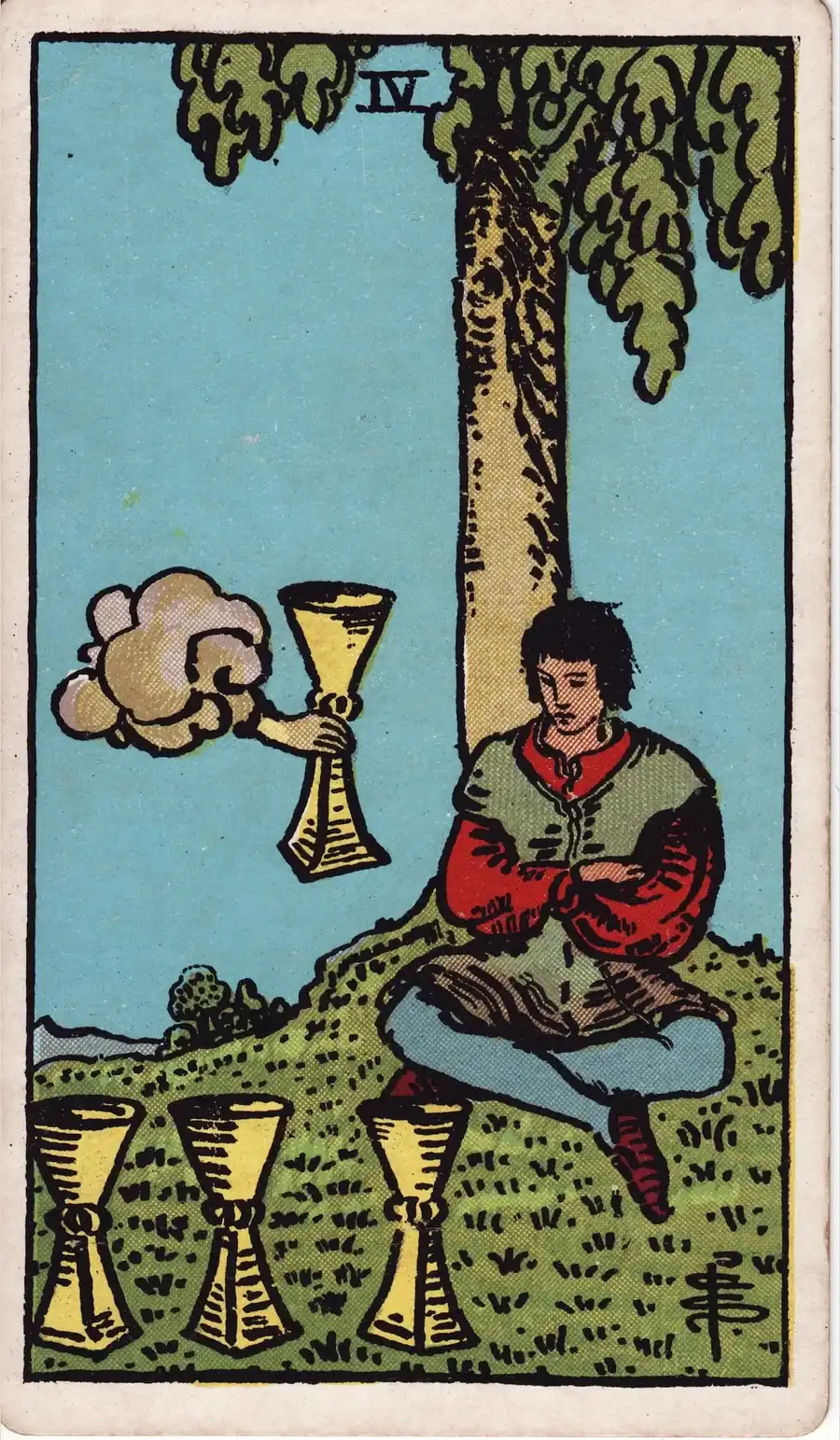
The Four of Cups shows a young man sitting under a tree with his arms folded, staring at three cups on the grass. A hand reaches out of a cloud to offer him a fourth cup, and he does not seem to notice.
It is a card of contemplation, apathy and missed chances. Here is what the Four of Cups means upright and reversed, the symbols in the 1909 card and a spread for when life feels flat.
Here is the Four of Cups at a glance.
| At a glance | This card |
|---|---|
| Upright keywords | contemplation, apathy, reevaluation |
| Reversed keywords | missed opportunities, boredom, dissatisfaction |
| Number | 4 in the suit of Cups |
| Golden Dawn title | Lord of Blended Pleasure Later tradition |
| Astrology | Moon in Cancer, third decan (20° to 30° Cancer) Later tradition |
| Tree of Life | Chesed (4), Mercy Later tradition |
| Suit and element | Cups, Water Later tradition |
| Yes or no | Maybe Modern |
Book T calls the Four of Cups the Lord of Blended Pleasure and gives it the Moon in Cancer, the last decan of the sign, on Chesed. The Moon rules Cancer, so this is water at its most inward and changeable. The title suggests pleasure with something mixed into it, which matches the young man’s mood under the tree.
Later tradition The Golden Dawn also gave each decan two of the 72 Goetic spirits, one for the day and one for the night. For the third decan of Cancer, and so for the Four of Cups, they are Sitri (spirit 12, day) and Haagenti (spirit 48, night). Their pages read the old entries as history; see the spirit directory for all 72.
The card: what Pamela Colman Smith drew
Waite wrote: “A young man is seated under a tree and contemplates three cups set on the grass before him; an arm issuing from a cloud offers him another cup. His expression notwithstanding is one of discontent with his environment.”
The folded arms. His arms are crossed and his body is closed. He is not open to receiving anything right now, either because he is thinking hard or because he is fed up.
The three cups. The three cups in front of him are what he already has. Like the man, we can stare at what we have until it stops looking like a gift.
The offered cup. A hand from a cloud, like the hand in the Aces, offers a new cup. Something new is available, and he is looking the other way.
Upright meaning
Upright, the Four of Cups is withdrawal and reflection. A young man sits under a tree with his arms crossed, staring at three cups on the grass, while a hand from a cloud offers him a fourth. He does not seem to notice. The card speaks of boredom, apathy, emotional fatigue, or a deliberate pause to think about what you really want.
It is not always negative. Sometimes stepping back is exactly right, especially if you have been chasing satisfaction in the wrong places. Meditation, solitude and saying no to things that do not interest you all belong here.
But the card also asks you to look up. Something new is being offered, and you may miss it if you keep staring at what already disappointed you. Look around before you decide nothing is good enough.
Reversed meaning
Reversed, the Four of Cups can show someone coming out of a period of withdrawal and finally noticing the offer in front of them. It can also mean the opposite: a deeper apathy, or a refusal to engage that has turned into a habit.
Ask whether you are resting or hiding. If you are ready, accept one invitation. If you are not ready, say so honestly instead of letting chances slip away by default.
A useful test is to name the three cups on the grass. What have you already been given that no longer interests you? Then name the fourth. If you cannot think of anything being offered, ask someone who knows you well. Others often see the hand from the cloud before we do.
In love, work and spirituality
In love. Upright: Boredom or emotional distance, or a need to reflect before committing. Reversed: Coming out of a slump, or ignoring a partner’s efforts.
At work. Upright: Disinterest in your role, or reflecting on what would be more meaningful. Reversed: Accepting an opportunity you had overlooked.
With money. Upright: Dissatisfaction with what you have, or reevaluating your financial goals. Reversed: Missing a good offer out of cynicism.
In spiritual practice. Upright: Meditation, retreat and looking within. Reversed: Apathy toward a practice that once fed you.
As feelings. Withdrawn, uncertain, or not fully present. They may be reconsidering.
As a person. Someone introspective, hard to impress, sometimes moody.
As advice. Look up from what disappointed you and notice what is being offered.
Reading the Four of Cups: positions and yes or no
In the past position: A period of withdrawal or boredom shaped your choices. In the present position: You may be missing something offered. Look up.
In the future position: A new opportunity will appear. Make sure you notice it. As advice: Take time to reflect, then say yes to one new thing.
In modern yes or no readings, the Four of Cups is a maybe. Inner reluctance makes the answer unclear for now.
What the Four means, and the history behind the card
Four brings stability, and in Cups stability can turn into stagnation. The Golden Dawn’s Blended Pleasure is a good description: enough is there, but the joy is mixed with restlessness.
Here is how the Four looks across the four suits:
- Four of Wands: celebration, harmony, homecoming
- Four of Cups (this card): contemplation, apathy, reevaluation
- Four of Swords: rest, recovery, contemplation
- Four of Pentacles: security, stability, materialism
When A. E. Waite published The Pictorial Key to the Tarot in 1910, he listed these divinatory meanings for the Four of Cups: “Weariness, disgust, aversion, imaginary vexations, as if the wine of this world had caused satiety only; another wine, as if a fairy gift, is now offered the wastrel, but he sees no consolation therein. This is also a card of blended pleasure.”
Reversed, he gave: “Novelty, presage, new instruction, new relations.”
Common questions
Is the Four of Cups a yes or no card? It is a maybe. The answer depends on whether you notice what is being offered.
What does the Four of Cups mean in love? Boredom, distraction or ignoring someone’s interest. Reversed, renewed attention.
Is the Four of Cups a bad card? Not really. It can be a healthy pause for reflection, as long as you do not miss the new cup being offered.
Try this
Try this small spread for the Four of Cups. Use it when life feels flat.
| Card | Question | What it shows |
|---|---|---|
| 1 | What am I staring at? | The thing I keep focusing on. |
| 2 | What am I not seeing? | The offer or gift I have missed. |
| 3 | What would bring life back? | One small change to try. |
Affirmation: I give my discontent a fair hearing before I decide.
Reversed affirmation: I move from pause into a choice I can stand behind.
If you keep a tarot journal, take one of these questions to it: What am I refusing, and why? What do I already have that I have stopped seeing? What would feel like a real offer to me right now?
What next
Cards that sit close to this one are The Hermit (the Major Arcana card of withdrawing to reflect), Eight of Cups (walking away when the cups stop feeding you) and Four of Swords (another Four of rest, this time for the mind).
The Four of Cups is part of the lesson Cups in my free Tarot for Beginners course. To see the whole suit on one page, go to the suit of Cups. To keep walking the suit, read the card before it, Three of Cups or the card after it, Five of Cups, or go back to all the card meanings.
For the suits and numbers in one place, see The Minor Arcana: suits and numbers made simple. For every card with keywords, affirmations and examples, see my book The Novice’s Guide to Tarot. If you would like a printable cheat sheet for all 78 cards, my 45-page Tarot Workbook is on Etsy.
Sources
- A. E. Waite, The Pictorial Key to the Tarot (London: Rider, 1910), Part III, sections 1 and 2.
- Pamela Colman Smith and A. E. Waite, the Rider-Waite-Smith tarot (London: Rider, 1909).
- Nicolas Conver, Tarot de Marseille (Marseille, 1760).
- Lauri Mukkala, The Novice’s Guide to Tarot, entry for the Four of Cups.
- Aleister Crowley, 777 (London: Walter Scott, 1909), columns of the decans, the Minor Arcana and the court cards.
- Israel Regardie, ed., The Golden Dawn (Chicago: Aries Press, 1937 to 1940), “Book T”, titles and attributions of the small cards and the court.
All 78 cards
Major Arcana
- The Fool
- The Magician
- The High Priestess
- The Empress
- The Emperor
- The Hierophant
- The Lovers
- The Chariot
- Strength
- The Hermit
- Wheel of Fortune
- Justice
- The Hanged Man
- Death
- Temperance
- The Devil
- The Tower
- The Star
- The Moon
- The Sun
- Judgement
- The World
Wands
- Ace of Wands
- Two of Wands
- Three of Wands
- Four of Wands
- Five of Wands
- Six of Wands
- Seven of Wands
- Eight of Wands
- Nine of Wands
- Ten of Wands
- Page of Wands
- Knight of Wands
- Queen of Wands
- King of Wands
Cups
- Ace of Cups
- Two of Cups
- Three of Cups
- Four of Cups
- Five of Cups
- Six of Cups
- Seven of Cups
- Eight of Cups
- Nine of Cups
- Ten of Cups
- Page of Cups
- Knight of Cups
- Queen of Cups
- King of Cups
Swords
- Ace of Swords
- Two of Swords
- Three of Swords
- Four of Swords
- Five of Swords
- Six of Swords
- Seven of Swords
- Eight of Swords
- Nine of Swords
- Ten of Swords
- Page of Swords
- Knight of Swords
- Queen of Swords
- King of Swords
Pentacles
Get the free Mini-Grimoire
A short printable starter guide to tarot and everyday witchcraft, plus my newsletter. Unsubscribe any time.
Opens Substack in a new tab to confirm. More about the newsletter · Privacy