


| Arcana | Minor Arcana: Wands |
|---|---|
| Image | RWS 1909 (PD) |
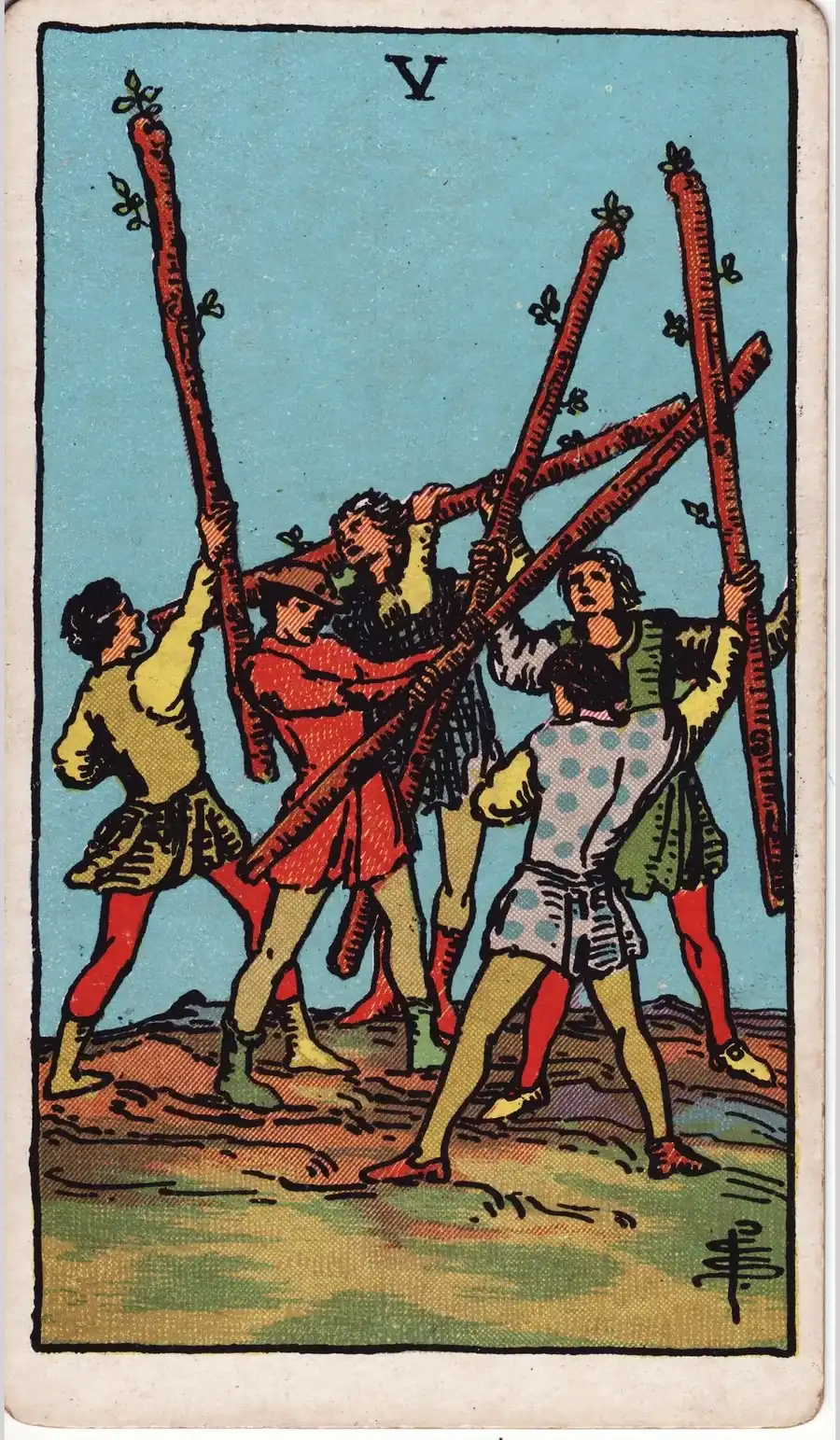
The Five of Wands shows five young men swinging staves at each other. Nobody is hurt, and nobody seems to be winning. It looks more like rough play than a real battle.
The card is about competition, conflict and the noise of too many people pushing at once. This page covers what the Five of Wands means upright and reversed, the symbols in the 1909 card and how to read it in love and work.
Here is the Five of Wands at a glance.
| At a glance | This card |
|---|---|
| Upright keywords | conflict, competition, tension |
| Reversed keywords | avoidance, lack of cooperation, inner conflict |
| Number | 5 in the suit of Wands |
| Golden Dawn title | Lord of Strife Later tradition |
| Astrology | Saturn in Leo, first decan (0° to 10° Leo) Later tradition |
| Tree of Life | Geburah (5), Severity Later tradition |
| Suit and element | Wands, Fire Later tradition |
| Yes or no | No Modern |
The Golden Dawn called the Five of Wands the Lord of Strife and gave it Saturn in Leo, the first decan of the sign, on Geburah, the fifth sephira of severity. Saturn’s weight in the Sun’s sign produces friction between pride and limits. Smith drew the strife as a game rather than a war, which is how most modern readers take it.
Later tradition The Golden Dawn also gave each decan two of the 72 Goetic spirits, one for the day and one for the night. For the first decan of Leo, and so for the Five of Wands, they are Beleth (spirit 13, day) and Crocell (spirit 49, night). Their pages read the old entries as history; see the spirit directory for all 72.
The card: what Pamela Colman Smith drew
Waite described “a posse of youths, who are brandishing staves, as if in sport or strife. It is mimic warfare.” Each young man wears different clothes, and their staves cross in every direction. There is no pattern and no leader, just energy colliding.
Mock fighting. The fight is “mimic warfare”, a game or a practice bout. That matters. The Five of Wands is usually a contest of egos and ideas, not a disaster. It can sharpen skills as much as it wastes energy.
Five different outfits. Every figure is dressed differently. They are five people with five agendas. The card often turns up when a group has not agreed on its goal or its rules.
Crossed staves. The wands cross in a messy tangle above their heads. If you look closely, nobody is actually hitting anyone. A lot of the conflict in this card is noise.
Upright meaning
Upright, the Five of Wands is noisy competition. Five young men swing staves at each other, but nobody is hurt and no one is winning. It looks like rough play or a training session, and that is the key: this is conflict as part of life, not a disaster.
The card often appears in brainstorming meetings, sports, creative rivalries and family arguments where everyone has an opinion. Healthy competition sharpens skill. Debate tests ideas. Much of the energy in this card is useful if it can be organized.
The difficulty is the lack of direction. Everyone is pointing their wand somewhere different. Ask what the group actually agrees on, and whether you need to win this argument or simply be heard in it.
Reversed meaning
Reversed, the Five of Wands can go two ways. It may mean the fighting is ending: people find a compromise, the competition settles, the room quiets down. Or it may show conflict that has gone underground, with avoidance, passive aggression and resentment instead of open debate.
Some readers also see inner conflict here, many voices in your own head pulling different ways. Write down each side of the argument as if it belonged to a different person. You will often find that two of them want the same thing.
In love, work and spirituality
In love. Upright: Playful bickering, competing schedules, or a rival for someone’s attention. Reversed: Arguments that have turned into silence, or a truce that is not quite peace.
At work. Upright: Competition for a role, a lively debate, a crowded market. Use it to improve your work. Reversed: Office politics, avoidance of hard conversations, or a conflict finally being resolved.
With money. Upright: Competing priorities for the same money. Decide which one leads. Reversed: Disputes over shared costs, or the relief of a settlement.
In spiritual practice. Upright: Testing your beliefs in honest debate, or a lively study group. Reversed: Arguing about who is doing a practice correctly instead of practicing.
As feelings. Frustration mixed with attraction. There may be sparks, but also friction.
As a person. A competitive, opinionated person who enjoys a good argument and can be exhausting to be around.
As advice. Choose your battles, and turn the competition into practice.
Reading the Five of Wands: positions and yes or no
In the past position: A period of rivalry or arguments shaped the situation. In the present position: There is friction around you. Decide which contests are worth your energy.
In the future position: Competition or a lively disagreement is coming. Prepare your position. As advice: Agree on the rules first, then compete fairly.
In modern yes or no readings, the Five of Wands leans no. It points to friction and competition, so the answer is not clear yet.
What the Five means, and the history behind the card
Five disrupts the stability of the Four, and in Wands the disruption is loud. The Golden Dawn’s Lord of Strife describes the energy, but Smith’s picture reminds you that strife can be a game you learn from.
Here is how the Five looks across the four suits:
- Five of Wands (this card): conflict, competition, tension
- Five of Cups: regret, loss, sorrow
- Five of Swords: conflict, defeat, betrayal
- Five of Pentacles: financial loss, poverty, insecurity
When A. E. Waite published The Pictorial Key to the Tarot in 1910, he listed these divinatory meanings for the Five of Wands: “Imitation, as, for example, sham fight, but also the strenuous competition and struggle of the search after riches and fortune. In this sense it connects with the battle of life. Hence some attributions say that it is a card of gold, gain, opulence.”
Reversed, he gave: “Litigation, disputes, trickery, contradiction.”
Common questions
Is the Five of Wands a yes or no card? It leans no, or not yet. There is too much friction for a clear answer.
Is the Five of Wands a bad card? Not really. It shows conflict, but often the kind that is noisy rather than harmful. Healthy competition can make everyone better.
What does the Five of Wands mean in love? Arguments, different styles or playful sparring. It asks you to negotiate instead of trying to win.
Try this
Try this small spread for the Five of Wands. Use it when you are caught in a conflict or a competition.
| Card | Question | What it shows |
|---|---|---|
| 1 | What is the fight really about? | The goal or need underneath the noise. |
| 2 | What is my part in it? | How I am adding to the tension, or not. |
| 3 | How can I change the game? | One step toward fair play or a clean exit. |
Affirmation: I meet competition with clear rules and proportional energy.
Reversed affirmation: I stop dodging needed conflict and stop battling myself by default.
If you keep a tarot journal, take one of these questions to it: Is this conflict teaching me something or only draining me? What are the actual rules everyone is playing by? Which of my own wants are fighting each other?
What next
Cards that sit close to this one are Five of Swords (another Five about conflict, where winning costs too much), Seven of Wands (standing your ground once the contest gets serious) and The Chariot (the Major Arcana card of pulling opposing forces in one direction).
The Five of Wands is part of the lesson Wands in my free Tarot for Beginners course. To see the whole suit on one page, go to the suit of Wands. To keep walking the suit, read the card before it, Four of Wands or the card after it, Six of Wands, or go back to all the card meanings.
For the suits and numbers in one place, see The Minor Arcana: suits and numbers made simple. For every card with keywords, affirmations and examples, see my book The Novice’s Guide to Tarot. If you would like a printable cheat sheet for all 78 cards, my 45-page Tarot Workbook is on Etsy.
Sources
- A. E. Waite, The Pictorial Key to the Tarot (London: Rider, 1910), Part III, sections 1 and 2.
- Pamela Colman Smith and A. E. Waite, the Rider-Waite-Smith tarot (London: Rider, 1909).
- Nicolas Conver, Tarot de Marseille (Marseille, 1760).
- Lauri Mukkala, The Novice’s Guide to Tarot, entry for the Five of Wands.
- Aleister Crowley, 777 (London: Walter Scott, 1909), columns of the decans, the Minor Arcana and the court cards.
- Israel Regardie, ed., The Golden Dawn (Chicago: Aries Press, 1937 to 1940), “Book T”, titles and attributions of the small cards and the court.
All 78 cards
Major Arcana
- The Fool
- The Magician
- The High Priestess
- The Empress
- The Emperor
- The Hierophant
- The Lovers
- The Chariot
- Strength
- The Hermit
- Wheel of Fortune
- Justice
- The Hanged Man
- Death
- Temperance
- The Devil
- The Tower
- The Star
- The Moon
- The Sun
- Judgement
- The World
Wands
- Ace of Wands
- Two of Wands
- Three of Wands
- Four of Wands
- Five of Wands
- Six of Wands
- Seven of Wands
- Eight of Wands
- Nine of Wands
- Ten of Wands
- Page of Wands
- Knight of Wands
- Queen of Wands
- King of Wands
Cups
- Ace of Cups
- Two of Cups
- Three of Cups
- Four of Cups
- Five of Cups
- Six of Cups
- Seven of Cups
- Eight of Cups
- Nine of Cups
- Ten of Cups
- Page of Cups
- Knight of Cups
- Queen of Cups
- King of Cups
Swords
- Ace of Swords
- Two of Swords
- Three of Swords
- Four of Swords
- Five of Swords
- Six of Swords
- Seven of Swords
- Eight of Swords
- Nine of Swords
- Ten of Swords
- Page of Swords
- Knight of Swords
- Queen of Swords
- King of Swords
Pentacles
Get the free Mini-Grimoire
A short printable starter guide to tarot and everyday witchcraft, plus my newsletter. Unsubscribe any time.
Opens Substack in a new tab to confirm. More about the newsletter · Privacy