


| Arcana | Minor Arcana: Wands |
|---|---|
| Image | RWS 1909 (PD) |
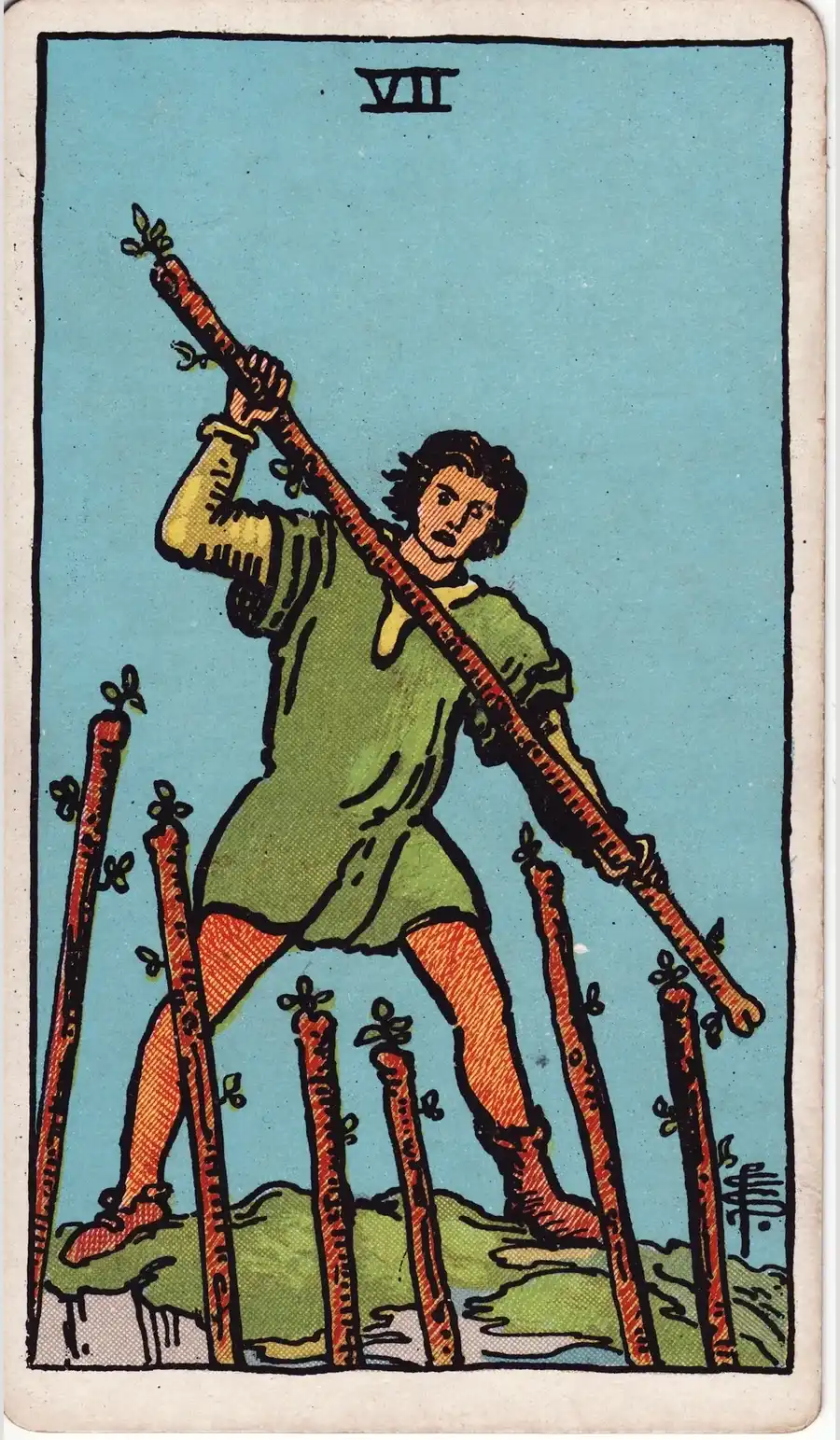
The Seven of Wands shows a young man on a hilltop, holding a wand across his body while six more wands rise toward him from below. He is on higher ground and outnumbered, and he is not backing down.
The card is about defending your position, your ideas or your boundaries. This page covers what the Seven of Wands means upright and reversed, the symbols in the 1909 card and a spread for standing your ground.
Here is the Seven of Wands at a glance.
| At a glance | This card |
|---|---|
| Upright keywords | defense, perseverance, challenge |
| Reversed keywords | overwhelm, giving up, vulnerability |
| Number | 7 in the suit of Wands |
| Golden Dawn title | Lord of Valour Later tradition |
| Astrology | Mars in Leo, third decan (20° to 30° Leo) Later tradition |
| Tree of Life | Netzach (7), Victory Later tradition |
| Suit and element | Wands, Fire Later tradition |
| Yes or no | Maybe Modern |
The Golden Dawn named the Seven of Wands the Lord of Valour and gave it Mars in Leo, the last decan of the sign, on Netzach, the seventh sephira. Mars brings courage to the proud sign, and the Order read the card as victory won against the odds, which matches Smith’s figure holding the high ground.
Later tradition The Golden Dawn also gave each decan two of the 72 Goetic spirits, one for the day and one for the night. For the third decan of Leo, and so for the Seven of Wands, they are Eligos (spirit 15, day) and Balam (spirit 51, night). Their pages read the old entries as history; see the spirit directory for all 72.
The card: what Pamela Colman Smith drew
Waite wrote: “A young man on a craggy eminence brandishing a staff; six other staves are raised towards him from below.” We never see who holds the other wands. Smith gave us only the defender, his feet planted on uneven ground.
The high ground. He stands above his challengers, which is an advantage. You have earned a position, a skill or a reputation, and now you are asked to keep it.
Mismatched shoes. Look at his feet: he wears a different shoe on each one. Many readers see a man who was caught off guard and had to dress in a hurry. The defense in this card often comes before you feel ready.
Six wands from below. The challengers are not shown, only their staves. Some of the opposition you face may be real, and some may be the volume of criticism rather than its weight.
Upright meaning
Upright, the Seven of Wands is the courage to defend what you have. The young man stands on higher ground and six wands rise toward him from below. He is outnumbered, but he is in a good position and he is not giving up. The card appears when your ideas, boundaries or achievements are being challenged.
It asks you to stand your ground. You may face competition after a success, criticism of a decision or simply the pressure of many demands at once. The Seven of Wands says you can hold your position if you stay focused and do not try to fight every wand at the same time.
Notice that his shoes do not match. Some readers take this as a sign that he was caught unprepared. Courage does not wait until everything is in order.
Reversed meaning
Reversed, the Seven of Wands shows the defender getting tired. You may feel overwhelmed, ready to give in, or unsure whether the position is worth holding. Sometimes the reversal points to defensiveness: treating every comment as an attack and fighting battles that no one is actually waging.
Ask what you are protecting and whether it still matters to you. If it does, ask for support and pick one front at a time. If it does not, letting go is not the same as losing.
In love, work and spirituality
In love. Upright: Defending a relationship against outside pressure, or holding a boundary you need. Reversed: Feeling under constant criticism, or being so defensive that a partner cannot reach you.
At work. Upright: Holding your position in a competitive field, defending a proposal, or protecting your team. Reversed: Burnout from fighting on every front, or giving up a role you earned.
With money. Upright: Protecting your savings and saying no to pressure to spend. Reversed: Feeling squeezed by many demands at once.
In spiritual practice. Upright: Holding to your path even when others question it. Reversed: Arguing with doubters instead of practicing.
As feelings. Protective, determined, perhaps guarded. They may feel they need to prove themselves.
As a person. A determined defender who does not back down easily, sometimes stubborn.
As advice. Hold your ground, but choose which challenges deserve your energy.
Reading the Seven of Wands: positions and yes or no
In the past position: You had to defend something important, and that fight still shapes you. In the present position: You are being challenged. Decide what is worth defending.
In the future position: A test of your position or your boundaries is coming. Prepare your footing. As advice: Pick one ground to hold and let the rest go.
In modern yes or no readings, the Seven of Wands is a maybe. It depends on whether you are willing and able to hold your ground.
What the Seven means, and the history behind the card
Seven tests what was won, and in Wands the test is courage. Valour is the Golden Dawn’s word for it: the willingness to stand alone on the hill when the easy choice would be to step down.
Here is how the Seven looks across the four suits:
- Seven of Wands (this card): defense, perseverance, challenge
- Seven of Cups: fantasy, illusion, choices
- Seven of Swords: deception, trickery, strategy
- Seven of Pentacles: patience, long-term planning, assessment
When A. E. Waite published The Pictorial Key to the Tarot in 1910, he listed these divinatory meanings for the Seven of Wands: “It is a card of valor, for, on the surface, six are attacking one, who has, however, the vantage position. On the intellectual plane, it signifies discussion, wordy strife; in business, negotiations, war of trade, barter, competition.”
Reversed, he gave: “Perplexity, embarrassments, anxiety. It is also a caution against indecision.”
Common questions
Is the Seven of Wands a yes or no card? It is a maybe. The outcome depends on whether you hold your position.
What does the Seven of Wands mean in love? Protecting your boundaries or your relationship from outside pressure. Reversed, feeling too worn out to speak up.
What is the difference between the Seven and the Nine of Wands? In the Seven you are actively defending. In the Nine the fight has gone on a long time, and you are wounded but still on guard.
Try this
Try this small spread for the Seven of Wands. Use it when you feel challenged or outnumbered.
| Card | Question | What it shows |
|---|---|---|
| 1 | What am I protecting? | The value, boundary or position at stake. |
| 2 | What is the real challenge? | The opposition that actually matters. |
| 3 | Where do I find support? | An ally, a rest or a smaller perimeter. |
Affirmation: I defend what matters and ignore contests that waste my fire.
Reversed affirmation: I recover my footing and choose which battles still deserve me.
If you keep a tarot journal, take one of these questions to it: What am I defending, and is it still mine to defend? Which criticism has weight, and which is only volume? Who could stand on this hill with me?
What next
Cards that sit close to this one are Nine of Wands (the guard who is still on watch after a long fight), Strength (the Major Arcana card of calm, steady courage) and Five of Wands (the noisy contest that comes before this one).
The Seven of Wands is part of the lesson Wands in my free Tarot for Beginners course. To see the whole suit on one page, go to the suit of Wands. To keep walking the suit, read the card before it, Six of Wands or the card after it, Eight of Wands, or go back to all the card meanings.
For the suits and numbers in one place, see The Minor Arcana: suits and numbers made simple. For every card with keywords, affirmations and examples, see my book The Novice’s Guide to Tarot. If you would like a printable cheat sheet for all 78 cards, my 45-page Tarot Workbook is on Etsy.
Sources
- A. E. Waite, The Pictorial Key to the Tarot (London: Rider, 1910), Part III, sections 1 and 2.
- Pamela Colman Smith and A. E. Waite, the Rider-Waite-Smith tarot (London: Rider, 1909).
- Nicolas Conver, Tarot de Marseille (Marseille, 1760).
- Lauri Mukkala, The Novice’s Guide to Tarot, entry for the Seven of Wands.
- Aleister Crowley, 777 (London: Walter Scott, 1909), columns of the decans, the Minor Arcana and the court cards.
- Israel Regardie, ed., The Golden Dawn (Chicago: Aries Press, 1937 to 1940), “Book T”, titles and attributions of the small cards and the court.
All 78 cards
Major Arcana
- The Fool
- The Magician
- The High Priestess
- The Empress
- The Emperor
- The Hierophant
- The Lovers
- The Chariot
- Strength
- The Hermit
- Wheel of Fortune
- Justice
- The Hanged Man
- Death
- Temperance
- The Devil
- The Tower
- The Star
- The Moon
- The Sun
- Judgement
- The World
Wands
- Ace of Wands
- Two of Wands
- Three of Wands
- Four of Wands
- Five of Wands
- Six of Wands
- Seven of Wands
- Eight of Wands
- Nine of Wands
- Ten of Wands
- Page of Wands
- Knight of Wands
- Queen of Wands
- King of Wands
Cups
- Ace of Cups
- Two of Cups
- Three of Cups
- Four of Cups
- Five of Cups
- Six of Cups
- Seven of Cups
- Eight of Cups
- Nine of Cups
- Ten of Cups
- Page of Cups
- Knight of Cups
- Queen of Cups
- King of Cups
Swords
- Ace of Swords
- Two of Swords
- Three of Swords
- Four of Swords
- Five of Swords
- Six of Swords
- Seven of Swords
- Eight of Swords
- Nine of Swords
- Ten of Swords
- Page of Swords
- Knight of Swords
- Queen of Swords
- King of Swords
Pentacles
Get the free Mini-Grimoire
A short printable starter guide to tarot and everyday witchcraft, plus my newsletter. Unsubscribe any time.
Opens Substack in a new tab to confirm. More about the newsletter · Privacy