


| Arcana | Minor Arcana: Swords |
|---|---|
| Image | RWS 1909 (PD) |
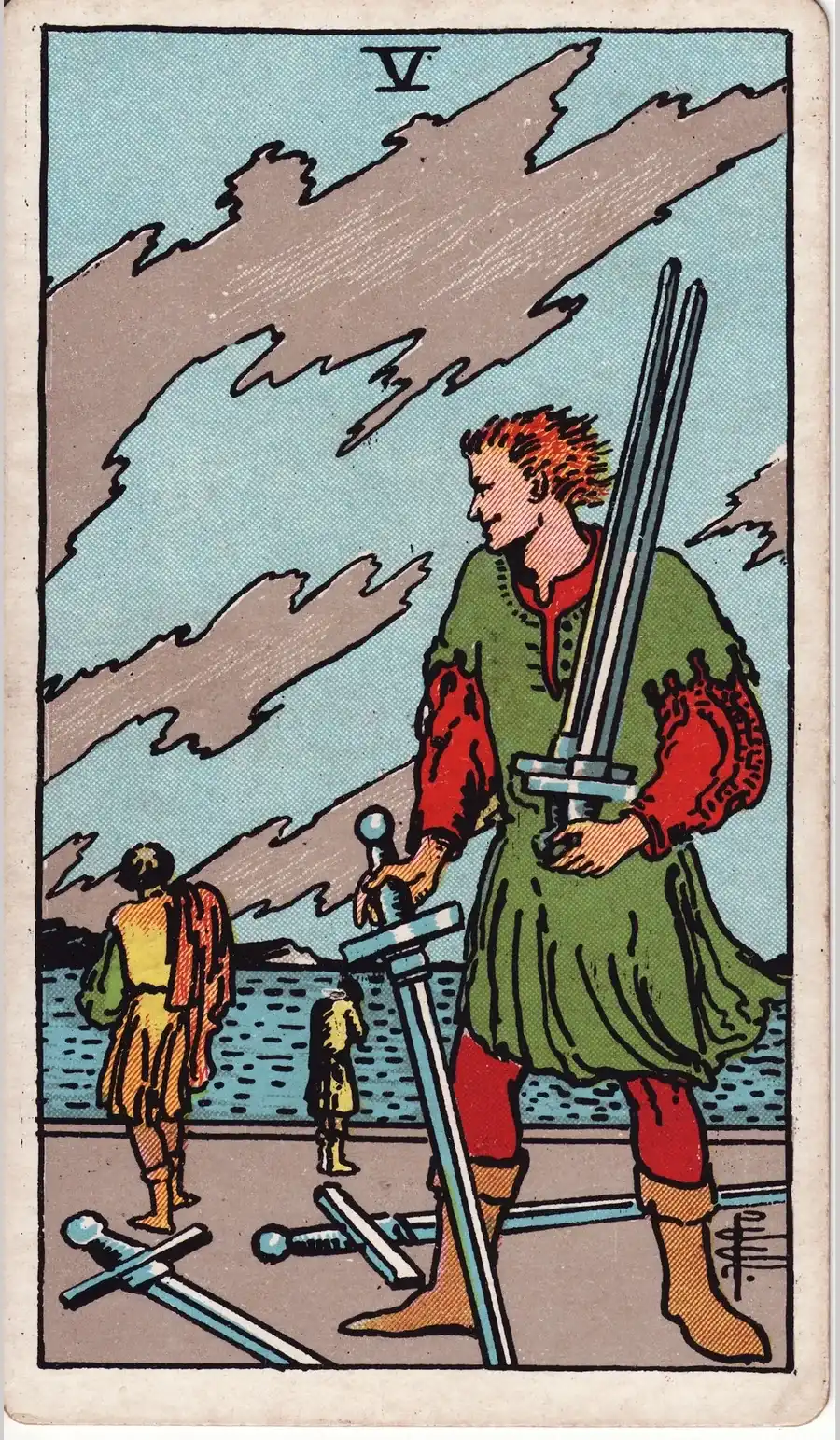
The Five of Swords shows a man holding three swords and smirking as two defeated figures walk away from him toward the sea. Two more swords lie on the ground. The sky is torn with clouds.
It is a card of conflict, defeat and a victory that costs too much. This page covers what the Five of Swords means upright and reversed, the symbols in the 1909 card and how to read it in love and work.
Here is the Five of Swords at a glance.
| At a glance | This card |
|---|---|
| Upright keywords | conflict, defeat, betrayal |
| Reversed keywords | reconciliation, making amends, past resentment |
| Number | 5 in the suit of Swords |
| Golden Dawn title | Lord of Defeat Later tradition |
| Astrology | Venus in Aquarius, first decan (0° to 10° Aquarius) Later tradition |
| Tree of Life | Geburah (5), Severity Later tradition |
| Suit and element | Swords, Air Later tradition |
| Yes or no | No Modern |
Book T calls the Five of Swords the Lord of Defeat and gives it Venus in Aquarius, the first decan of the sign, on Geburah. Venus is not comfortable in the cool sign of Saturn, and the result is a victory that costs more than it wins.
Later tradition The Golden Dawn also gave each decan two of the 72 Goetic spirits, one for the day and one for the night. For the first decan of Aquarius, and so for the Five of Swords, they are Foras (spirit 31, day) and Amdusias (spirit 67, night). Their pages read the old entries as history; see the spirit directory for all 72.
The card: what Pamela Colman Smith drew
Waite wrote: “A disdainful man looks after two retreating and dejected figures. Their swords lie upon the ground. He carries two others on his left shoulder, and a third sword is in his right hand, point to earth. He is the master in possession of the field.”
The smirk. He looks pleased with himself. He has won the argument or the battle, and everyone else has left.
The walking figures. Two people walk away, one with his face in his hands. Somebody paid for the victory.
The torn sky. The clouds are ragged, as if after a storm. The air is not clear yet.
Upright meaning
Upright, the Five of Swords is a hollow victory. A man smirks as he holds three swords, while two defeated figures walk away toward the sea. Two more swords lie on the ground. The sky is torn with clouds. The card speaks of conflict in which someone wins and everyone loses something.
It appears in arguments, competition and power struggles. Sometimes you are the winner who has gone too far. Sometimes you are the one walking away. Either way, the card asks what the conflict has cost, and whether winning was worth it.
There is also a lesson about pride. Not every fight needs to be won. Sometimes leaving the field is the wiser choice.
Reversed meaning
Reversed, the Five of Swords can show reconciliation, making amends or letting go of resentment. It can also show conflict that keeps coming back, or old grudges that have never been resolved.
Ask what you could let go of to make peace. If you were wronged, decide whether you need justice or simply distance.
If you are the one walking away in the picture, the reversed Five may ask whether you still need to hear an apology to move on. Sometimes you do, and it is fair to ask for one. Sometimes the healthier path is to leave the swords on the ground.
In love, work and spirituality
In love. Upright: Arguments, power struggles, or a partner who needs to win. Reversed: Making peace after a fight, or old resentment resurfacing.
At work. Upright: Office politics, ruthless competition, or winning at a cost. Reversed: Making amends, or the end of a conflict.
With money. Upright: Gains made unfairly, or a dispute over money. Reversed: Settling a dispute.
In spiritual practice. Upright: Learning humility. Reversed: Releasing resentment.
As feelings. Defensive or resentful. There may be tension.
As a person. Someone competitive who may care more about winning than about people.
As advice. Choose your battles, and ask what winning will cost.
Reading the Five of Swords: positions and yes or no
In the past position: A painful conflict shaped this situation. In the present position: A fight is costing more than it is worth.
In the future position: Conflict may come. Choose your battles. As advice: Ask whether winning is worth it.
In modern yes or no readings, the Five of Swords leans no. Conflict points to no.
What the Five means, and the history behind the card
Five disrupts the balance of Four. In Swords the disruption is conflict, and the Golden Dawn’s Lord of Defeat reminds you that someone always loses.
Here is how the Five looks across the four suits:
- Five of Wands: conflict, competition, tension
- Five of Cups: regret, loss, sorrow
- Five of Swords (this card): conflict, defeat, betrayal
- Five of Pentacles: financial loss, poverty, insecurity
The sky in this card is torn with sharp, ragged clouds, and the water in the background is unsettled. The man in front gathers swords and smiles, while two figures walk away from him toward the shore, one with his head in his hands.
Two swords lie on the ground. Many readers ask the same question of this card: who are you in the picture? The winner, the ones walking away, or the person watching? Each answer gives a different reading.
When A. E. Waite published The Pictorial Key to the Tarot in 1910, he listed these divinatory meanings for the Five of Swords: “Degradation, destruction, revocation, infamy, dishonor, loss, with the variants and analogues of these.” Reversed, he gave: “The same; burial and obsequies.”
Common questions
Is the Five of Swords a yes or no card? It leans no. It shows conflict that costs too much.
What does the Five of Swords mean in love? Arguments where someone needs to win. Reversed, reconciliation.
What does the Five of Swords mean reversed? Making amends, or lingering resentment after a fight.
Try this
Try this small spread for the Five of Swords. Use it after a painful argument.
| Card | Question | What it shows |
|---|---|---|
| 1 | What was the fight about? | The real issue underneath. |
| 2 | What did it cost? | What was hurt or lost. |
| 3 | How can I repair or release it? | One step toward peace. |
Affirmation: I refuse victories that destroy what I care about.
Reversed affirmation: I release pointless battles and make amends where I can.
If you keep a tarot journal, take one of these questions to it: What am I fighting for, really? Where have I won and still lost? What would repair look like?
What next
Cards that sit close to this one are Five of Wands (a noisier, lighter conflict), Seven of Swords (another card of tricks and taking) and Justice (the Major Arcana card of fairness).
The Five of Swords is part of the lesson Swords in my free Tarot for Beginners course. To see the whole suit on one page, go to the suit of Swords. To keep walking the suit, read the card before it, Four of Swords or the card after it, Six of Swords, or go back to all the card meanings.
For the suits and numbers in one place, see The Minor Arcana: suits and numbers made simple. For every card with keywords, affirmations and examples, see my book The Novice’s Guide to Tarot. If you would like a printable cheat sheet for all 78 cards, my 45-page Tarot Workbook is on Etsy.
Sources
- A. E. Waite, The Pictorial Key to the Tarot (London: Rider, 1910), Part III, sections 1 and 2.
- Pamela Colman Smith and A. E. Waite, the Rider-Waite-Smith tarot (London: Rider, 1909).
- Nicolas Conver, Tarot de Marseille (Marseille, 1760).
- Lauri Mukkala, The Novice’s Guide to Tarot, entry for the Five of Swords.
- Aleister Crowley, 777 (London: Walter Scott, 1909), columns of the decans, the Minor Arcana and the court cards.
- Israel Regardie, ed., The Golden Dawn (Chicago: Aries Press, 1937 to 1940), “Book T”, titles and attributions of the small cards and the court.
All 78 cards
Major Arcana
- The Fool
- The Magician
- The High Priestess
- The Empress
- The Emperor
- The Hierophant
- The Lovers
- The Chariot
- Strength
- The Hermit
- Wheel of Fortune
- Justice
- The Hanged Man
- Death
- Temperance
- The Devil
- The Tower
- The Star
- The Moon
- The Sun
- Judgement
- The World
Wands
- Ace of Wands
- Two of Wands
- Three of Wands
- Four of Wands
- Five of Wands
- Six of Wands
- Seven of Wands
- Eight of Wands
- Nine of Wands
- Ten of Wands
- Page of Wands
- Knight of Wands
- Queen of Wands
- King of Wands
Cups
- Ace of Cups
- Two of Cups
- Three of Cups
- Four of Cups
- Five of Cups
- Six of Cups
- Seven of Cups
- Eight of Cups
- Nine of Cups
- Ten of Cups
- Page of Cups
- Knight of Cups
- Queen of Cups
- King of Cups
Swords
- Ace of Swords
- Two of Swords
- Three of Swords
- Four of Swords
- Five of Swords
- Six of Swords
- Seven of Swords
- Eight of Swords
- Nine of Swords
- Ten of Swords
- Page of Swords
- Knight of Swords
- Queen of Swords
- King of Swords
Pentacles
Get the free Mini-Grimoire
A short printable starter guide to tarot and everyday witchcraft, plus my newsletter. Unsubscribe any time.
Opens Substack in a new tab to confirm. More about the newsletter · Privacy