


| Arcana | Minor Arcana: Pentacles |
|---|---|
| Image | RWS 1909 (PD) |
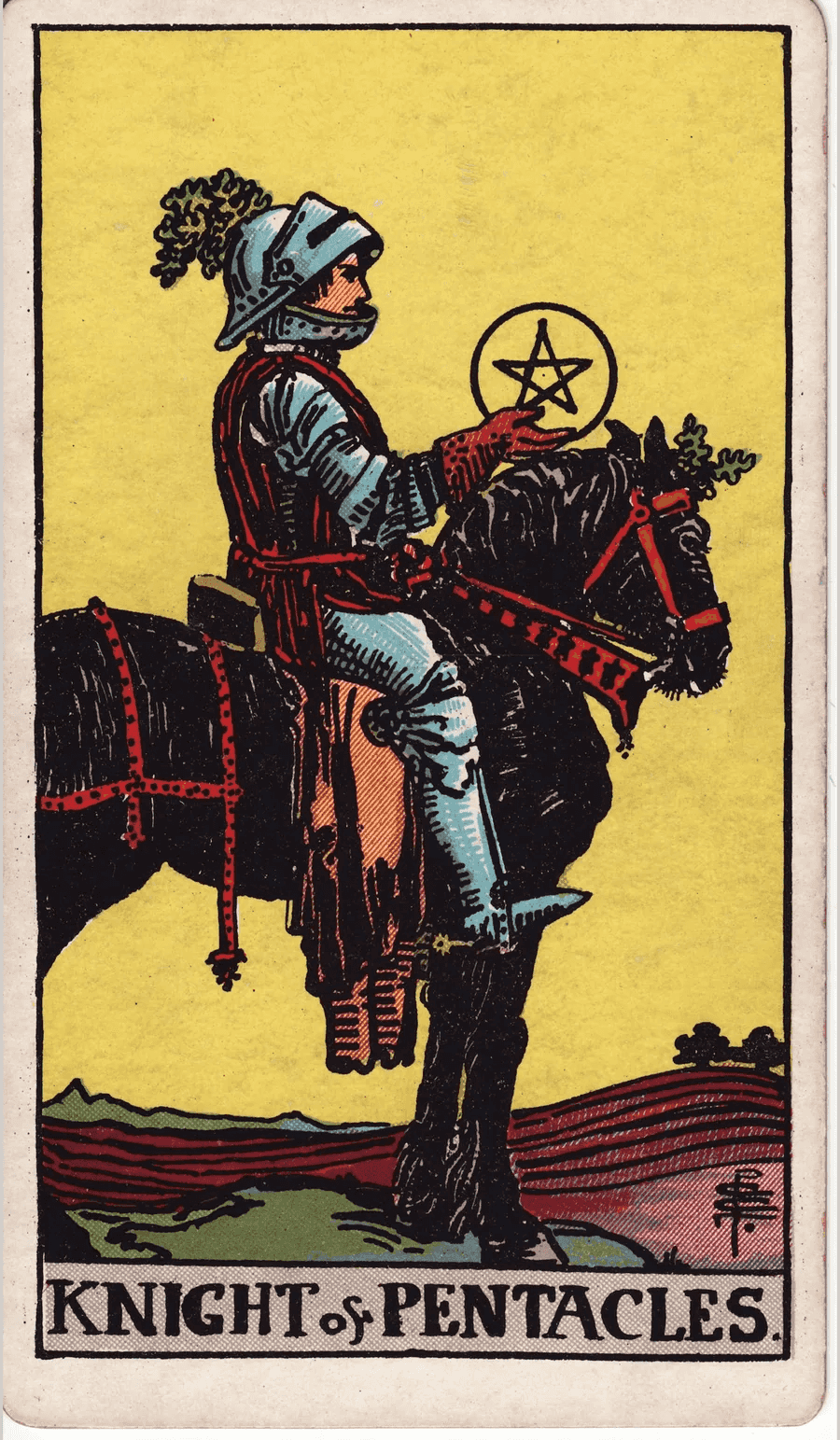
The Knight of Pentacles sits on a heavy black horse that is standing still in a plowed field. He holds a pentacle in his hand and does not seem to be in any hurry. He is the slowest and steadiest Knight in tarot. This page covers what the Knight of Pentacles means upright and reversed, the symbols in the 1909 card and how to read him as a person or an energy.
At a glance
- Upright keywords: hard work, responsibility, routine
- Reversed keywords: stubbornness, laziness, lack of progress
- Rank: Knight, one of the four court cards of Pentacles
- Suit and element: Pentacles, Earth Later tradition
- Astrology: Mercury, Virgo Modern
- Yes or no: Maybe Modern
The pairing of suits and elements comes from French occult writers of the 1800s, and the Golden Dawn fixed the version used here in the 1880s and 1890s. The astrology line is the pairing printed on my first tarot deck. Other books pair the Aces and court cards differently, so if yours disagrees, follow your own deck. The yes or no lean is a modern reading habit. Use these layers if they help you remember the card, and skip them if they get in the way.
The card: what Pamela Colman Smith drew
Waite wrote: “He rides a slow, enduring, heavy horse, to which his own aspect corresponds. He exhibits his symbol, but does not look therein.” All the other Knights move. This one waits.
The still horse
His horse is a heavy working animal standing still. Steady effort, not speed.
The plowed field
The field has been prepared. He is responsible for the slow work of growing things.
Holding the pentacle
He holds his coin steady. He is reliable with what he has been given.
Upright meaning
Upright, the Knight of Pentacles gives attention to the commitments that need regular care. This is the approach of someone who checks the details, keeps an agreement and returns to the task after the initial excitement has faded. In a reading, the Knight can invite dependable action where intentions have so far remained vague.
Choose a pace that you can realistically maintain. If a project matters, decide when you will work on it and what a completed session involves. Reliability also includes communicating when plans change.
Reversed meaning
Reversed, the Knight of Pentacles can show stubbornness, laziness or no progress. Steady becomes stuck.
Ask whether routine still serves the goal. Change one small thing to get moving.
Reversals are optional. Many readers never use them and read every card upright, and that is a complete way to read. If you do use them, decide before you shuffle what a reversed card will mean for you, and keep to that choice for the whole reading.
In love, work and spirituality
Love
Upright, a loyal, reliable partner. Reversed, a relationship stuck in routine.
Work and money
Hard work, reliability, routine tasks done well. Reversed, stagnation.
Spirituality
A steady daily practice. Reversed, practice done only out of habit.
As feelings
As someone’s feelings, the Knight of Pentacles shows steady, loyal interest. They are slow to move but serious.
The Knight of Pentacles as past, present, future and advice
- Past: Steady work got you here.
- Present: Keep going, steadily.
- Future: A slow, reliable time is ahead.
- Advice: Keep your commitments.
A Minor Arcana card usually describes the everyday texture of a situation: a mood, a conversation, a task or a step. If the Knight of Pentacles appears next to a Major Arcana card, let the Major name the big theme and let this card show how it is playing out in the body and the other things Pentacles rule. If it keeps coming back over several days, write down what was happening each time.
Is the Knight of Pentacles a yes or a no?
In modern yes or no readings, the Knight of Pentacles is a maybe. Progress is slow, so it is a maybe. Tarot is better at showing the shape of a situation than at handing down verdicts, so if the question really matters, turn it into an open question such as “What do I need to know about this?” and draw again.
Affirmation and journal prompts
Affirmation: I honor my commitments with steady and realistic effort.
Reversed affirmation: I adapt my routines to support useful progress.
Journal prompts:
- What needs my steady care?
- Where am I steady, and where am I stuck?
- What pace can I keep?
The knight in the tarot court
The Knight is the suit in motion: pursuit, commitment in transit and sometimes too much of the suit’s own style. Knights travel. They bring change, and they can overdo things. Court cards are not limited by the gender of the figure on the card: a Queen can describe a man, and a Knight can describe a plan rather than a person. You can read the Knight of Pentacles as someone in your life, as a part of you, or as an approach to the situation.
Here is how the Knight looks across the four suits:
- Knight of Wands: energy, passion, impulsiveness
- Knight of Cups: romance, charm, idealism
- Knight of Swords: action, ambition, drive
- Knight of Pentacles (this card): hard work, responsibility, routine
Learning a rank across the suits is one of the fastest ways to learn the Minor Arcana: the number or court rank gives you the shape, and the suit gives you the setting.
The history and art behind the card
In most decks before 1909, the number cards showed only a pattern of suit symbols, the way a playing card does. The Sola Busca deck from late 1400s Italy is the famous exception. Pamela Colman Smith gave every Minor Arcana card a scene with people in it, and that choice is a big reason the Rider-Waite-Smith deck is still the easiest deck for beginners. In Italian decks the suit is Denari (coins) and in the Tarot de Marseille it is Deniers, round coins. Occult writers of the 1800s, and then the Golden Dawn, turned the coins into pentacles, discs engraved with a five-pointed star, and Smith followed that. Waite noted that “in old Tarot packs this suit represented money”, but on this site I read it more widely as everything material you tend.
Waite called his mount a slow, enduring, heavy horse, and the picture makes that clear: of the four Knights, he is the only one whose horse stands still. The Knight of Wands rears, the Knight of Cups walks gently and the Knight of Swords charges. Behind this Knight lies a ploughed field, ready for planting. Comparing the four Knights side by side is one of the quickest ways to learn the elements, and this one shows earth at its most patient.
When A. E. Waite published The Pictorial Key to the Tarot in 1910, he listed these divinatory meanings for the Knight of Pentacles: “Utility, serviceableness, interest, responsibility, rectitude, all on the normal and external plane.” Reversed, he gave: “Inertia, idleness, repose of that kind, stagnation; also placidity, discouragement, carelessness.” Waite said he was offering “a harmony of their meanings” gathered “from all sources”, which means older fortune-telling lists, not his own reading of the picture. On this site I read the picture first and treat lists like this as history.
A spread for the Knight of Pentacles
Use this spread for long, slow projects.
- What needs regular care? The commitment.
- What pace can I keep? The rhythm.
- What will help me continue? The support.
Lay the three cards in a row, read each one on its own first, then read them together as a short story. Write one sentence for each position and one small action you will take.
Common questions
Is the Knight of Pentacles a yes or no card?
It is a maybe. Progress is slow but steady.
Who is the Knight of Pentacles as a person?
Often a reliable, hardworking, patient person. It can be any gender.
What does the Knight of Pentacles mean in love?
Loyalty and reliability. Reversed, routine.
Related cards
- Knight of Wands: the fastest Knight, for contrast
- The Hermit: the Major Arcana card of patient wisdom
- Seven of Pentacles: patient work
Keep learning
The Knight of Pentacles is part of the lesson Meet the court in my free Tarot for Beginners course. To see the whole suit on one page, go to the suit of Pentacles. To keep walking the suit, read the card before it, Page of Pentacles or the card after it, Queen of Pentacles, or go back to all the card meanings. For more on the court, see Tarot court cards without confusion. For every card with keywords, affirmations and examples, see my book The Novice’s Guide to Tarot. If you would like a printable cheat sheet for all 78 cards, my 45-page Tarot Workbook is on Etsy.
Sources
- A. E. Waite, The Pictorial Key to the Tarot (London: Rider, 1910), Part III, sections 1 and 2.
- Pamela Colman Smith and A. E. Waite, the Rider-Waite-Smith tarot (London: Rider, 1909).
- Nicolas Conver, Tarot de Marseille (Marseille, 1760).
- Lauri Mukkala, The Novice’s Guide to Tarot, entry for the Knight of Pentacles.
All 78 cards
Major Arcana
- The Fool
- The Magician
- The High Priestess
- The Empress
- The Emperor
- The Hierophant
- The Lovers
- The Chariot
- Strength
- The Hermit
- Wheel of Fortune
- Justice
- The Hanged Man
- Death
- Temperance
- The Devil
- The Tower
- The Star
- The Moon
- The Sun
- Judgement
- The World
Wands
- Ace of Wands
- Two of Wands
- Three of Wands
- Four of Wands
- Five of Wands
- Six of Wands
- Seven of Wands
- Eight of Wands
- Nine of Wands
- Ten of Wands
- Page of Wands
- Knight of Wands
- Queen of Wands
- King of Wands
Cups
- Ace of Cups
- Two of Cups
- Three of Cups
- Four of Cups
- Five of Cups
- Six of Cups
- Seven of Cups
- Eight of Cups
- Nine of Cups
- Ten of Cups
- Page of Cups
- Knight of Cups
- Queen of Cups
- King of Cups
Swords
- Ace of Swords
- Two of Swords
- Three of Swords
- Four of Swords
- Five of Swords
- Six of Swords
- Seven of Swords
- Eight of Swords
- Nine of Swords
- Ten of Swords
- Page of Swords
- Knight of Swords
- Queen of Swords
- King of Swords
Pentacles
Get the free Mini-Grimoire
A short printable starter guide to tarot and everyday witchcraft, plus my newsletter. Unsubscribe any time.
Opens Substack in a new tab to confirm. More about the newsletter · Privacy