


| Arcana | Minor Arcana: Swords |
|---|---|
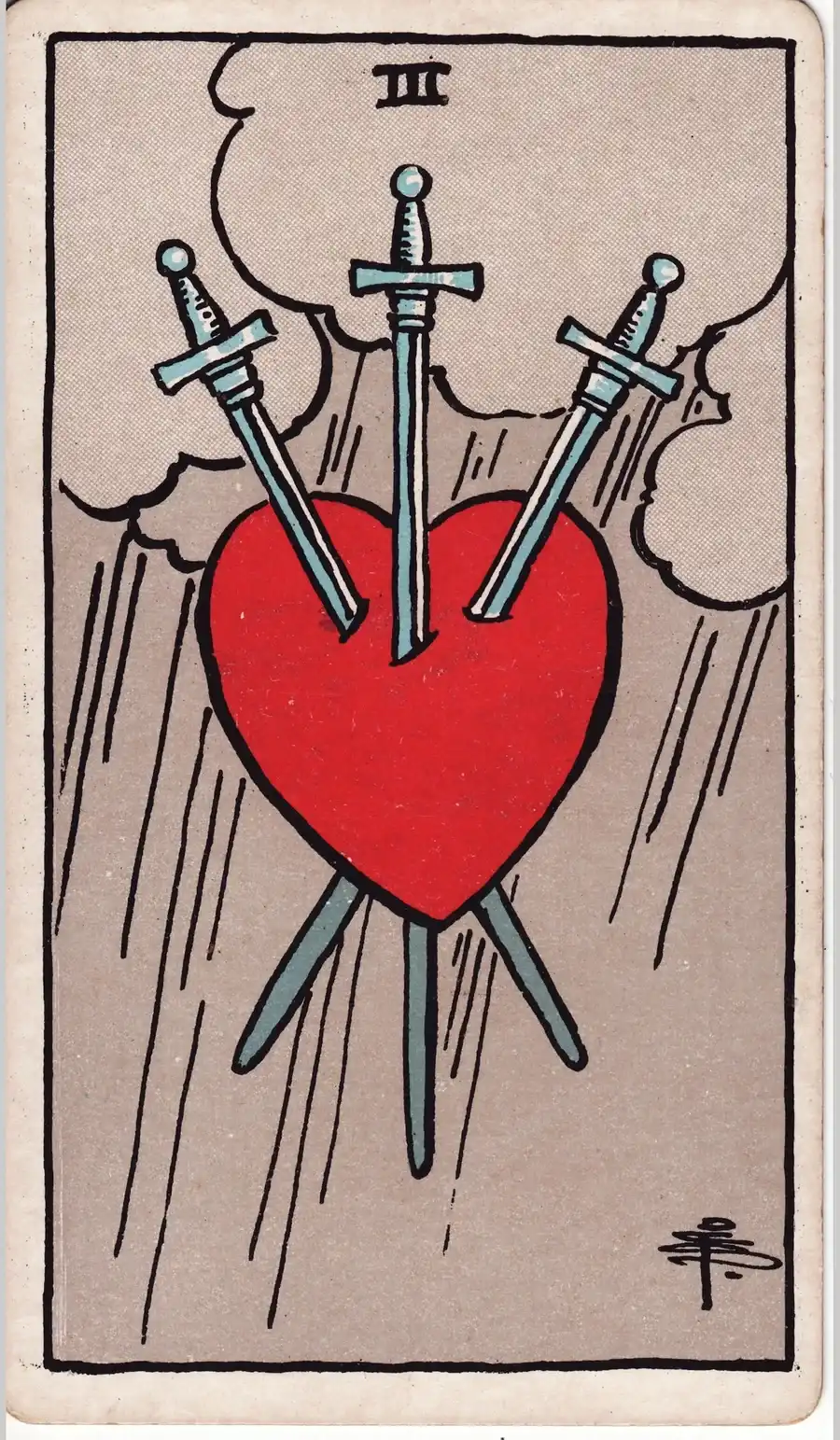
| Image | RWS 1909 (PD) |
The Three of Swords is one of the most famous images in tarot: a red heart pierced by three swords, with storm clouds and rain behind it. It names heartbreak, sorrow and painful truth.
It is also a card of healing, once the rain has passed. This page covers what the Three of Swords means upright and reversed, the history behind its striking picture and a gentle spread for heartache.
Here is the Three of Swords at a glance.
| At a glance | This card |
|---|---|
| Upright keywords | heartbreak, sorrow, betrayal |
| Reversed keywords | recovery, forgiveness, healing |
| Number | 3 in the suit of Swords |
| Golden Dawn title | Lord of Sorrow Later tradition |
| Astrology | Saturn in Libra, second decan (10° to 20° Libra) Later tradition |
| Tree of Life | Binah (3), Understanding Later tradition |
| Suit and element | Swords, Air Later tradition |
| Yes or no | No Modern |
Book T calls the Three of Swords the Lord of Sorrow and gives it Saturn in Libra, the middle decan of the sign, on Binah. Saturn is exalted in Libra, so the sorrow here is serious and structural, not merely a passing mood. In Golden Dawn Qabalah, Binah is also the Great Sea, called Marah, a name that means bitter.
Later tradition The Golden Dawn also gave each decan two of the 72 Goetic spirits, one for the day and one for the night. For the second decan of Libra, and so for the Three of Swords, they are Purson (spirit 20, day) and Gremory (spirit 56, night). Their pages read the old entries as history; see the spirit directory for all 72.
The card: what Pamela Colman Smith drew
Waite described it plainly: “Three swords piercing a heart; cloud and rain behind.” There are no people. Smith made the feeling itself the subject.
The pierced heart. The heart is pierced three times. It is a picture of pain that is impossible to miss. The card does not hide or soften the hurt.
Three swords. Swords are thoughts and words. Heartbreak in this card often comes from words spoken, truths learned or a story we told ourselves that turned out to be false.
The rain. Rain falls behind the heart. Rain is also release. Tears, like weather, pass.
Upright meaning
Upright, the Three of Swords is heartbreak. A red heart is pierced by three swords against a gray sky full of rain. It is one of the most direct images in tarot, and it means what it shows: grief, sorrow, betrayal, painful truth or a loss that cuts deep.
The card does not soften the pain, and it should not be softened. But notice that the heart is not destroyed. It is pierced, and rain is falling, the kind of rain that cleans and eventually ends. The Three of Swords often marks the moment when the truth comes out and the hurt begins, which is also the moment healing can start.
Let yourself feel it. Pain that is denied tends to stay longer.
Reversed meaning
Reversed, the Three of Swords shows recovery: the swords being pulled out one by one, forgiveness, or the first day you notice you have not cried. It can also show pain that is being held in, old grief that has never healed, or refusing to acknowledge hurt.
Ask whether you are healing or hiding. If you need support, ask for it. Grief shared is easier to carry.
In a past position, the reversed Three often points to an old heartbreak that still shapes how you love or trust. It does not mean you are broken. It means a scar is asking for attention, perhaps through talking, writing, therapy or ritual.
In love, work and spirituality
In love. Upright: Heartbreak, betrayal, a painful truth or separation. Reversed: Healing after a breakup, or forgiveness.
At work. Upright: Disappointment, painful criticism, or a project that fails. Reversed: Recovering from a work setback.
With money. Upright: A painful financial loss. Reversed: Learning from a loss and moving on.
In spiritual practice. Upright: Working through grief as a spiritual practice. Reversed: Releasing old pain.
As feelings. Hurt, sadness or disappointment.
As a person. Someone grieving or recently hurt.
As advice. Let yourself feel the grief, and let the rain wash it through.
Reading the Three of Swords: positions and yes or no
In the past position: A heartbreak shaped you, and it may still ache. In the present position: There is pain here. Let yourself feel it.
In the future position: Hard news may come, and you will heal. As advice: Be honest about the hurt and be gentle with yourself.
In modern yes or no readings, the Three of Swords leans no. Sorrow points to no.
What the Three means, and the history behind the card
Three in Swords is the first wound of the mind and heart. The Golden Dawn’s Lord of Sorrow names it plainly.
Here is how the Three looks across the four suits:
- Three of Wands: progress, foresight, exploration
- Three of Cups: celebration, friendship, creativity
- Three of Swords (this card): heartbreak, sorrow, betrayal
- Three of Pentacles: collaboration, skill, teamwork
Smith’s heart with three swords has an older relative. The Sola Busca deck from late 1400s Italy shows a heart pierced by three swords on its own Three of Swords, and photographs of that deck reached the British Museum in London in 1907, just before Smith made her drawings.
It is likely that she saw them. The image of a heart pierced by swords is also familiar from Christian art of the Sorrowful Mother, Mary with her heart pierced by seven swords.
When A. E. Waite published The Pictorial Key to the Tarot in 1910, he listed these divinatory meanings for the Three of Swords: “Removal, absence, delay, division, rupture, dispersion, and all that the design signifies naturally, being too simple and obvious to call for specific enumeration.”
Reversed, he gave: “Mental alienation, error, loss, distraction, disorder, confusion.”
Common questions
Is the Three of Swords a yes or no card? It leans no. It shows sorrow and painful truth.
Does the Three of Swords always mean a breakup? No. It can be any heartbreak or painful truth, including grief, disappointment or betrayal by a friend.
What does the Three of Swords mean reversed? Healing, forgiveness and recovery. The pain is starting to ease.
Try this
Use this gentle spread when your heart hurts.
| Card | Question | What it shows |
|---|---|---|
| 1 | What hurts? | The pain to name honestly. |
| 2 | What truth does it show me? | What I have learned. |
| 3 | What helps me heal? | One kind thing for myself. |
Affirmation: I let heartbreak be true without making it my only story.
Reversed affirmation: I recover at an honest pace and forgive on my own terms.
If you keep a tarot journal, take one of these questions to it: What hurt am I carrying that I have not named? What truth did this pain reveal? Who could I share this with?
What next
Cards that sit close to this one are Five of Cups (grief and regret in the water suit), Ten of Swords (the painful ending at the end of the suit) and The Tower (the Major Arcana card of sudden painful truth).
The Three of Swords is part of the lesson Swords in my free Tarot for Beginners course. To see the whole suit on one page, go to the suit of Swords. To keep walking the suit, read the card before it, Two of Swords or the card after it, Four of Swords, or go back to all the card meanings.
For the suits and numbers in one place, see The Minor Arcana: suits and numbers made simple. For every card with keywords, affirmations and examples, see my book The Novice’s Guide to Tarot. If you would like a printable cheat sheet for all 78 cards, my 45-page Tarot Workbook is on Etsy.
Sources
- A. E. Waite, The Pictorial Key to the Tarot (London: Rider, 1910), Part III, sections 1 and 2.
- Pamela Colman Smith and A. E. Waite, the Rider-Waite-Smith tarot (London: Rider, 1909).
- Nicolas Conver, Tarot de Marseille (Marseille, 1760).
- The Sola Busca tarot (northern Italy, late fifteenth century), Pinacoteca di Brera, Milan.
- Lauri Mukkala, The Novice’s Guide to Tarot, entry for the Three of Swords.
- Aleister Crowley, 777 (London: Walter Scott, 1909), columns of the decans, the Minor Arcana and the court cards.
- Israel Regardie, ed., The Golden Dawn (Chicago: Aries Press, 1937 to 1940), “Book T”, titles and attributions of the small cards and the court.
All 78 cards
Major Arcana
- The Fool
- The Magician
- The High Priestess
- The Empress
- The Emperor
- The Hierophant
- The Lovers
- The Chariot
- Strength
- The Hermit
- Wheel of Fortune
- Justice
- The Hanged Man
- Death
- Temperance
- The Devil
- The Tower
- The Star
- The Moon
- The Sun
- Judgement
- The World
Wands
- Ace of Wands
- Two of Wands
- Three of Wands
- Four of Wands
- Five of Wands
- Six of Wands
- Seven of Wands
- Eight of Wands
- Nine of Wands
- Ten of Wands
- Page of Wands
- Knight of Wands
- Queen of Wands
- King of Wands
Cups
- Ace of Cups
- Two of Cups
- Three of Cups
- Four of Cups
- Five of Cups
- Six of Cups
- Seven of Cups
- Eight of Cups
- Nine of Cups
- Ten of Cups
- Page of Cups
- Knight of Cups
- Queen of Cups
- King of Cups
Swords
- Ace of Swords
- Two of Swords
- Three of Swords
- Four of Swords
- Five of Swords
- Six of Swords
- Seven of Swords
- Eight of Swords
- Nine of Swords
- Ten of Swords
- Page of Swords
- Knight of Swords
- Queen of Swords
- King of Swords
Pentacles
Get the free Mini-Grimoire
A short printable starter guide to tarot and everyday witchcraft, plus my newsletter. Unsubscribe any time.
Opens Substack in a new tab to confirm. More about the newsletter · Privacy