


| Arcana | Minor Arcana: Swords |
|---|---|
| Image | RWS 1909 (PD) |
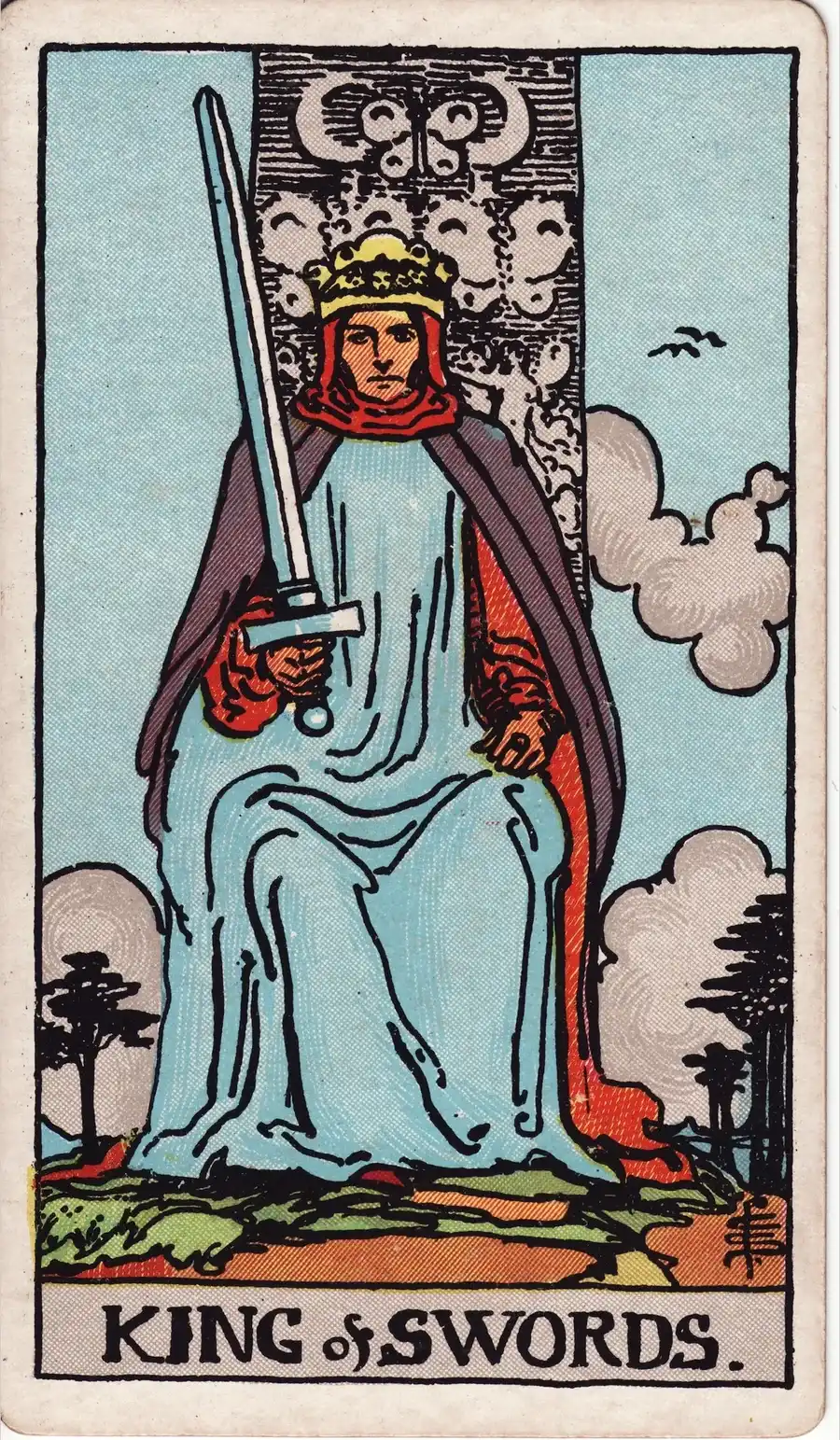
The King of Swords sits facing us directly on his throne, holding his sword upright. He looks straight at you. He is the master of the air suit: authority, truth and clear judgment.
Here is what the King of Swords means upright and reversed, the symbols in the 1909 card and how to read him as a person or an energy.
Here is the King of Swords at a glance.
| At a glance | This card |
|---|---|
| Upright keywords | authority, truth, intellectual power |
| Reversed keywords | tyranny, manipulation, misuse of power |
| Rank | King, one of the four court cards of Swords |
| Golden Dawn title | Prince of the Chariots of the Winds Later tradition |
| Golden Dawn rank | Prince in the Golden Dawn and in Crowley’s Thoth deck Later tradition |
| Element within the suit | Air of Air Later tradition |
| Astrology | In Book T, 20° Capricorn to 20° Aquarius Later tradition |
| Tree of Life | Tiphareth (6), Beauty Later tradition |
| Astrology printed on my first deck | Mercury, Aquarius Modern |
| Suit and element | Swords, Air Later tradition |
| Yes or no | Yes Modern |
Waite’s King corresponds to the Golden Dawn’s Prince. The Prince of Swords is the Prince of the Chariots of the Winds, Air of Air, on Tiphareth, ruling 20° Capricorn to 20° Aquarius. Crowley also calls him a Prince. Many modern books give the element of fire to the King instead, so pairings in other guides may differ.
The card: what Pamela Colman Smith drew
Waite wrote: “He sits in judgment, holding the unsheathed sign of his suit. He recalls, of course, the conventional Symbol of Justice in the Trumps Major, and he may represent this virtue, but he is rather the power of life and death, in virtue of his office.”
Facing forward. He is one of the few court figures who looks straight at you. He meets things head on.
The sword. His sword is unsheathed and upright, like the sword of Justice. He judges.
The butterflies and birds. Like the Queen’s throne, his has butterflies, and birds fly behind him. Air is his element.
Upright meaning
Upright, the King of Swords is authority through intellect. He sits facing us directly on his throne, holding his sword upright. He looks straight at you. He is the master of air: clear judgment, honest truth, fair decisions and the courage to make hard choices.
He is the judge, the lawyer, the scientist, the leader who decides on evidence rather than emotion. In readings he asks you to think clearly, weigh the facts and make a decision you can stand behind.
He faces you directly. That is his integrity. He does not hide behind charm or emotion.
Reversed meaning
Reversed, the King of Swords can show misuse of power, manipulation, or a cold intellect that ignores people. He may use logic to control, or truth as a weapon.
Ask whether your judgment includes compassion. A reversed King often needs to listen as well as decide.
In legal or official matters, the reversed King suggests getting independent advice and putting agreements in writing. Not every authority is fair, and the remedy for unfair judgment is often more information and a witness, not a louder argument.
In love, work and spirituality
In love. Upright: A fair, honest and intelligent partner. Reversed: A controlling or cold partner.
At work. Upright: Leadership, legal matters, clear decisions and integrity. Reversed: Abuse of authority, or rigid thinking.
With money. Upright: Sound, fact-based financial decisions. Reversed: Manipulation in financial matters.
In spiritual practice. Upright: A clear-minded teacher, or ethical clarity. Reversed: Intellectualizing spirituality.
As feelings. Respect and admiration. They may be reserved about emotions.
As a person. An intelligent, fair and authoritative person.
As advice. Decide clearly and fairly.
Reading the King of Swords: positions and yes or no
In the past position: A clear decision or an authority figure shaped this. In the present position: Think clearly and decide fairly.
In the future position: Expert advice or a clear judgment is coming. As advice: Hold a fair standard.
In modern yes or no readings, the King of Swords leans yes. Clear judgment points to yes.
The king in the tarot court, and the history behind the card
Kings hold the outward mastery of the suit. In the air suit, that mastery is fair judgment, truth spoken with authority.
Here is how the King looks across the four suits:
- King of Wands: leadership, vision, determination
- King of Cups: emotional balance, diplomacy, wisdom
- King of Swords (this card): authority, truth, intellectual power
- King of Pentacles: wealth, abundance, leadership
Waite noted that the King recalls the figure of Justice in the Major Arcana, and the two cards are worth comparing. Both sit facing forward with a raised sword. Butterflies are carved on his throne, as on his Queen’s, and birds fly in the sky behind him.
Waite also called him the power of life and death, in virtue of his office, which is a reminder that this card is about authority. Fair judgment is a responsibility, not only a talent.
When A. E. Waite published The Pictorial Key to the Tarot in 1910, he listed these divinatory meanings for the King of Swords: “Whatsoever arises out of the idea of judgment and all its connections, power, command, authority, militant intelligence, law, offices of the crown, and so forth.”
Reversed, he gave: “Cruelty, perversity, barbarity, perfidy, evil intention.”
Common questions
Is the King of Swords a yes or no card? It leans yes, based on clear thinking.
Who is the King of Swords as a person? Often an intelligent, fair, authoritative person, such as a professional or expert. Court cards can describe any gender.
What does the King of Swords mean in love? Mature, clear-headed love. Reversed, coldness or control.
Try this
Try this small spread for the King of Swords. Use it when you have to make a fair decision.
| Card | Question | What it shows |
|---|---|---|
| 1 | What are the facts? | What I know for certain. |
| 2 | What is fair? | The just outcome. |
| 3 | How do I decide? | The clear step. |
Affirmation: I wield clear judgment with fairness and accountability.
Reversed affirmation: I refuse intellectual bullying and reclaim fair authority.
If you keep a tarot journal, take one of these questions to it: What standard do I want to hold? Where is my authority, and how do I use it? Is my logic fair to people’s feelings?
What next
Cards that sit close to this one are Justice (the Major Arcana card he recalls), The Emperor (the Major Arcana card of authority) and Queen of Swords (his partner on the air throne).
The King of Swords is part of the lesson Meet the court in my free Tarot for Beginners course. To see the whole suit on one page, go to the suit of Swords. To keep walking the suit, read the card before it, Queen of Swords, or go back to all the card meanings.
For more on the court, see Tarot court cards without confusion. For every card with keywords, affirmations and examples, see my book The Novice’s Guide to Tarot. If you would like a printable cheat sheet for all 78 cards, my 45-page Tarot Workbook is on Etsy.
Sources
- A. E. Waite, The Pictorial Key to the Tarot (London: Rider, 1910), Part III, sections 1 and 2.
- Pamela Colman Smith and A. E. Waite, the Rider-Waite-Smith tarot (London: Rider, 1909).
- Nicolas Conver, Tarot de Marseille (Marseille, 1760).
- Lauri Mukkala, The Novice’s Guide to Tarot, entry for the King of Swords.
- Aleister Crowley, 777 (London: Walter Scott, 1909), columns of the decans, the Minor Arcana and the court cards.
- Israel Regardie, ed., The Golden Dawn (Chicago: Aries Press, 1937 to 1940), “Book T”, titles and attributions of the small cards and the court.
All 78 cards
Major Arcana
- The Fool
- The Magician
- The High Priestess
- The Empress
- The Emperor
- The Hierophant
- The Lovers
- The Chariot
- Strength
- The Hermit
- Wheel of Fortune
- Justice
- The Hanged Man
- Death
- Temperance
- The Devil
- The Tower
- The Star
- The Moon
- The Sun
- Judgement
- The World
Wands
- Ace of Wands
- Two of Wands
- Three of Wands
- Four of Wands
- Five of Wands
- Six of Wands
- Seven of Wands
- Eight of Wands
- Nine of Wands
- Ten of Wands
- Page of Wands
- Knight of Wands
- Queen of Wands
- King of Wands
Cups
- Ace of Cups
- Two of Cups
- Three of Cups
- Four of Cups
- Five of Cups
- Six of Cups
- Seven of Cups
- Eight of Cups
- Nine of Cups
- Ten of Cups
- Page of Cups
- Knight of Cups
- Queen of Cups
- King of Cups
Swords
- Ace of Swords
- Two of Swords
- Three of Swords
- Four of Swords
- Five of Swords
- Six of Swords
- Seven of Swords
- Eight of Swords
- Nine of Swords
- Ten of Swords
- Page of Swords
- Knight of Swords
- Queen of Swords
- King of Swords
Pentacles
Get the free Mini-Grimoire
A short printable starter guide to tarot and everyday witchcraft, plus my newsletter. Unsubscribe any time.
Opens Substack in a new tab to confirm. More about the newsletter · Privacy