


| Arcana | Minor Arcana: Wands |
|---|---|
| Image | RWS 1909 (PD) |
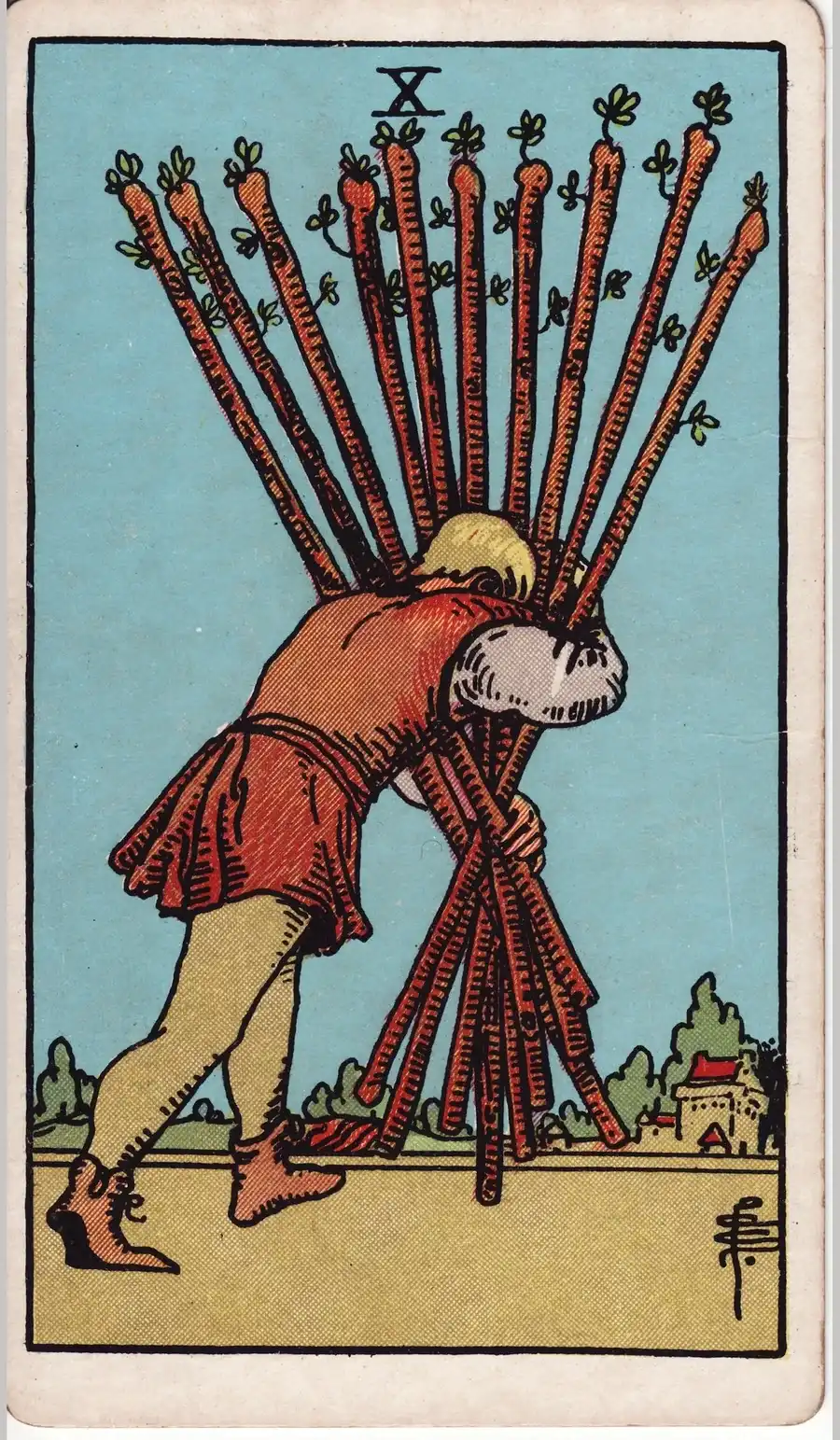
The Ten of Wands shows a man bent over a bundle of ten wands, carrying them toward a town he can barely see past the load. He is nearly there, but the weight has taken over his whole view.
The card is about burden, responsibility and hard work. This page covers what the Ten of Wands means upright and reversed, the symbols Pamela Colman Smith drew and a spread for sharing the load.
Here is the Ten of Wands at a glance.
| At a glance | This card |
|---|---|
| Upright keywords | burden, responsibility, hard work |
| Reversed keywords | burnout, dumping the load, overwhelm |
| Number | 10 in the suit of Wands |
| Golden Dawn title | Lord of Oppression Later tradition |
| Astrology | Saturn in Sagittarius, third decan (20° to 30° Sagittarius) Later tradition |
| Tree of Life | Malkuth (10), the Kingdom Later tradition |
| Suit and element | Wands, Fire Later tradition |
| Yes or no | No Modern |
Book T calls the Ten of Wands the Lord of Oppression and gives it Saturn in Sagittarius, the last decan of the sign, on Malkuth, the tenth sephira, the physical world. Saturn’s weight on the free-roaming archer is a neat picture of fire weighed down by duty, which is what Smith drew.
Later tradition The Golden Dawn also gave each decan two of the 72 Goetic spirits, one for the day and one for the night. For the third decan of Sagittarius, and so for the Ten of Wands, they are Ronove (spirit 27, day) and Andras (spirit 63, night). Their pages read the old entries as history; see the spirit directory for all 72.
The card: what Pamela Colman Smith drew
Waite kept his description short: “A man oppressed by the weight of the ten staves which he is carrying.” Smith drew him with his face hidden behind the wands, so he cannot see where he is going. The houses ahead are close.
The bundle of wands. He holds the wands in an awkward bundle instead of carrying them in a sensible way. Many readers see a load that is heavy partly because of how it is held.
The hidden face. The wands block his view. When you carry too much, the task becomes the only thing you can see, and you lose sight of why you started.
The town ahead. His destination is near. The burden has an end point. The card can mean the last heavy mile before you finally put things down.
Upright meaning
Upright, the Ten of Wands is the weight of too much. The man is bent over a bundle of ten wands, and he can barely see where he is going. He is close to the town, so the end is near, but the load has taken over his whole view. The card appears when you have said yes too often, taken responsibility for everyone else, or let a project grow larger than one person can carry.
It is not a card of failure. He is still walking and he will probably arrive. But it asks what you are carrying that is not yours, and whether the way you carry it is making the journey harder than it needs to be. Bundled differently, the same load can be lighter.
This card also marks the end of the fire cycle. What started as a spark in the Ace has turned into a heavy duty. That is a reason to put some of it down, not to drop the whole thing.
Reversed meaning
Reversed, the Ten of Wands can show collapse under the weight, burnout or a breakdown in health or morale. It can also show the opposite: finally putting the bundle down, delegating, or saying no to a role that drained you.
Look at which reading is true for you. If you are close to collapsing, rest is not optional. If you have already let things go, notice how much lighter you feel and resist the temptation to pick everything up again.
In love, work and spirituality
In love. Upright: Carrying more than your share in a relationship or family. Reversed: Resentment from imbalance, or finally sharing the load fairly.
At work. Upright: Heavy workload, deadlines, a project that has grown too big. Delegate where you can. Reversed: Burnout, or quitting a role that was crushing you.
With money. Upright: Debts or obligations that feel heavy. Reversed: Releasing a financial burden, or the risk of ignoring it until it collapses.
In spiritual practice. Upright: A practice that has turned into an obligation. Simplify it. Reversed: Letting go of spiritual duties that no longer serve you.
As feelings. Tired and stretched. They care but feel they have too much to give right now.
As a person. A hard worker who takes on everything and finds it hard to say no.
As advice. Put down what is not yours to carry.
Reading the Ten of Wands: positions and yes or no
In the past position: You carried a heavy load, and you may still be tired from it. In the present position: You are carrying too much. Look at what you can put down.
In the future position: A demanding stretch is ahead. Plan your help now. As advice: Delegate one task this week.
In modern yes or no readings, the Ten of Wands leans no. It shows overload, so the answer leans no until the burden is lighter.
What the Ten means, and the history behind the card
Ten completes the suit, and in Wands completion feels heavy. The Golden Dawn named it Oppression, which is a strong word, but it points to what happens when energy has no outlet: it becomes weight.
Here is how the Ten looks across the four suits:
- Ten of Wands (this card): burden, responsibility, hard work
- Ten of Cups: harmony, joy, shared belonging
- Ten of Swords: betrayal, painful endings, collapse
- Ten of Pentacles: legacy, inheritance, long-term success
Pamela Colman Smith seems to have borrowed from the older Sola Busca deck here. In 1907 photographs of that late fifteenth century Italian deck were given to the British Museum in London, and Smith and Waite were likely able to see them.
The figure and pose in her Ten of Wands closely resemble the Sola Busca Ten of Swords, so the idea of a person bent under a load of the suit’s tools may be over 400 years old.
When A. E. Waite published The Pictorial Key to the Tarot in 1910, he listed these divinatory meanings for the Ten of Wands: “A card of many significances, and some of the readings cannot be harmonized. I set aside that which connects it with honor and good faith.”
Reversed, he gave: “Contrarieties, difficulties, intrigues, and their analogies.”
Common questions
Is the Ten of Wands a yes or no card? It leans no, or not until you lighten your load.
What does the Ten of Wands mean in love? Uneven effort, or stress from outside the relationship. It asks you to share responsibility fairly.
What does the Ten of Wands mean as an outcome? You will get there, but at a cost. Look at whether you can reach the same goal with less strain.
Try this
Try this small spread for the Ten of Wands. Use it when you feel overloaded.
| Card | Question | What it shows |
|---|---|---|
| 1 | What am I carrying that is mine? | The responsibility I choose to keep. |
| 2 | What can I share or drop? | The load to hand over or let go. |
| 3 | What is the destination? | What all this effort is for. |
Affirmation: I carry what is mine and put down what is crushing me.
Reversed affirmation: I release overload before burnout finishes the job for me.
If you keep a tarot journal, take one of these questions to it: Which of the things I carry are truly mine? Who could I ask for help, and what stops me? What would I see if I put the load down for one day?
What next
Cards that sit close to this one are Nine of Wands (the last stand before the overload), Four of Pentacles (holding on too tightly, in the earth suit) and The Hanged Man (the Major Arcana card of pausing and seeing things from a new angle).
The Ten of Wands is part of the lesson Wands in my free Tarot for Beginners course. To see the whole suit on one page, go to the suit of Wands. To keep walking the suit, read the card before it, Nine of Wands or the card after it, Page of Wands, or go back to all the card meanings.
For the suits and numbers in one place, see The Minor Arcana: suits and numbers made simple. For every card with keywords, affirmations and examples, see my book The Novice’s Guide to Tarot. If you would like a printable cheat sheet for all 78 cards, my 45-page Tarot Workbook is on Etsy.
Sources
- A. E. Waite, The Pictorial Key to the Tarot (London: Rider, 1910), Part III, sections 1 and 2.
- Pamela Colman Smith and A. E. Waite, the Rider-Waite-Smith tarot (London: Rider, 1909).
- Nicolas Conver, Tarot de Marseille (Marseille, 1760).
- The Sola Busca tarot (northern Italy, late fifteenth century), Pinacoteca di Brera, Milan.
- Lauri Mukkala, The Novice’s Guide to Tarot, entry for the Ten of Wands.
- Aleister Crowley, 777 (London: Walter Scott, 1909), columns of the decans, the Minor Arcana and the court cards.
- Israel Regardie, ed., The Golden Dawn (Chicago: Aries Press, 1937 to 1940), “Book T”, titles and attributions of the small cards and the court.
All 78 cards
Major Arcana
- The Fool
- The Magician
- The High Priestess
- The Empress
- The Emperor
- The Hierophant
- The Lovers
- The Chariot
- Strength
- The Hermit
- Wheel of Fortune
- Justice
- The Hanged Man
- Death
- Temperance
- The Devil
- The Tower
- The Star
- The Moon
- The Sun
- Judgement
- The World
Wands
- Ace of Wands
- Two of Wands
- Three of Wands
- Four of Wands
- Five of Wands
- Six of Wands
- Seven of Wands
- Eight of Wands
- Nine of Wands
- Ten of Wands
- Page of Wands
- Knight of Wands
- Queen of Wands
- King of Wands
Cups
- Ace of Cups
- Two of Cups
- Three of Cups
- Four of Cups
- Five of Cups
- Six of Cups
- Seven of Cups
- Eight of Cups
- Nine of Cups
- Ten of Cups
- Page of Cups
- Knight of Cups
- Queen of Cups
- King of Cups
Swords
- Ace of Swords
- Two of Swords
- Three of Swords
- Four of Swords
- Five of Swords
- Six of Swords
- Seven of Swords
- Eight of Swords
- Nine of Swords
- Ten of Swords
- Page of Swords
- Knight of Swords
- Queen of Swords
- King of Swords
Pentacles
Get the free Mini-Grimoire
A short printable starter guide to tarot and everyday witchcraft, plus my newsletter. Unsubscribe any time.
Opens Substack in a new tab to confirm. More about the newsletter · Privacy